IOTAIdentity atlas  ·  round thirteen  ·  3 October 2026
Braid, evolved  /  three permutations and the sea

The strands stay. The rope does not.

Braid was the closest in style, and its ending was too literal a rope. Each of the three below keeps Braid's lines and its work running along them, opens in a way learned from the age1 film, and ends as the layered model Macrocosmos draws: twenty machines on a ring, joined across the centre, eight layers. Same arc and one clock in all; the brand world's palette. The fourth, Sea, answers the note on the first three: the opening should be an actual ocean, and the ocean should be what becomes the model.

The two references

How it opens, and what it becomes.

age1, the hero film (frames at 0, 3, 4.5, 6 and 10 seconds). A small grey body lights; its branches open outward, tips lit; then one long strand grows across to another. Taken from it: the order (dim, lit, open, reach), the lit tips, strands that grow and are loose until they land. Not taken: the neuron itself, the blue and red, the soft 3D.

Macrocosmos, the training dashboard. Nodes on a ring, joined across the centre by straight lines whose crossings form rings; one node lit; "Layers 8". Taken: the figure and the count of layers. Not taken: any number on the panel; those belong to their demo.

Permutation 1

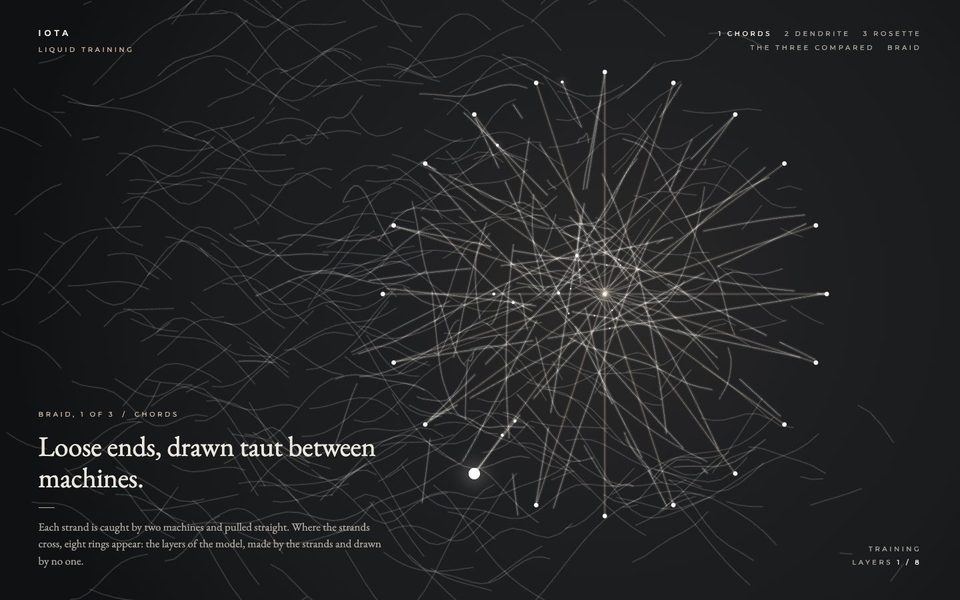
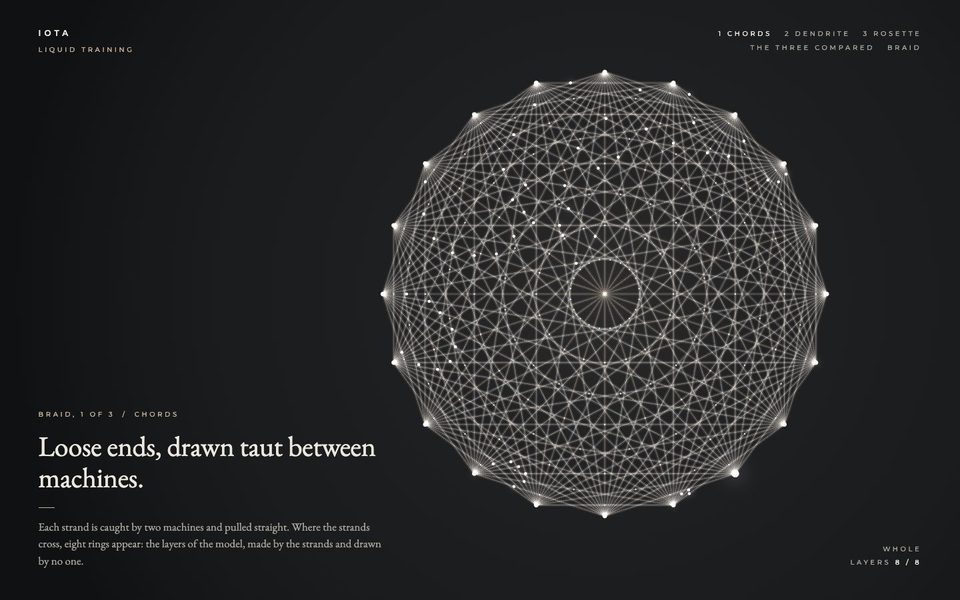
Chords: loose ends, drawn taut between machines.
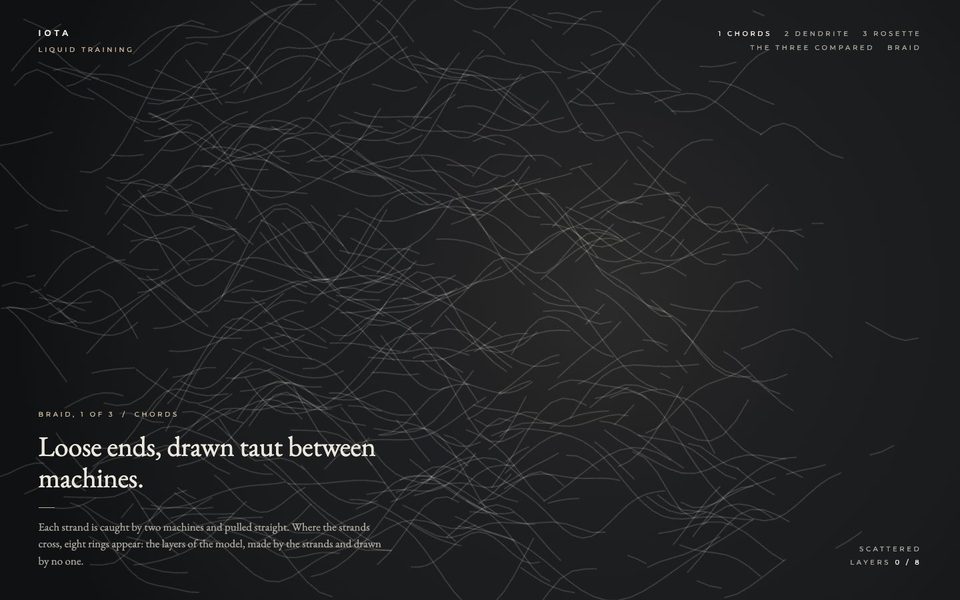
Loose, broken strands wandering across the frame
2 s · scattered
Strands being caught by nodes and pulled toward straight lines
10 s · training
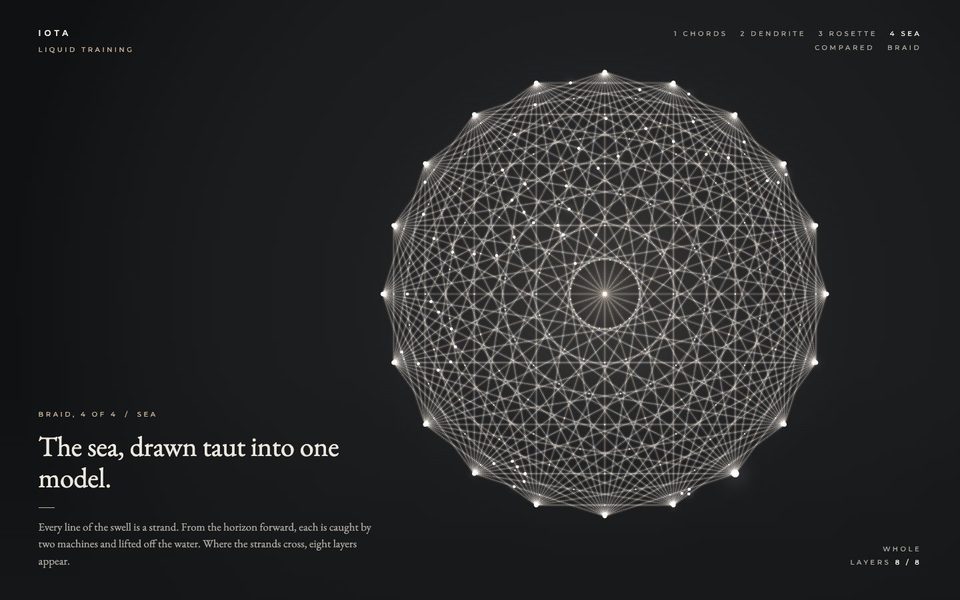
A ring of twenty nodes joined by chords whose crossings form eight nested rings
24 s · whole
From Braid and age1
Braid's opening exactly: the same loose, broken strands. From age1, only the bow of a strand as it is thrown before it is pulled in.
From Macrocosmos
The whole end state. Each strand is one chord; the eight rings are where the chords cross, so the strands build the layers and nothing is drawn on top.
Where it falls short
No rope left at all, and little of age1's opening: the strands do not branch or grow. The closest to their model; the least new.
Open live →
Permutation 2

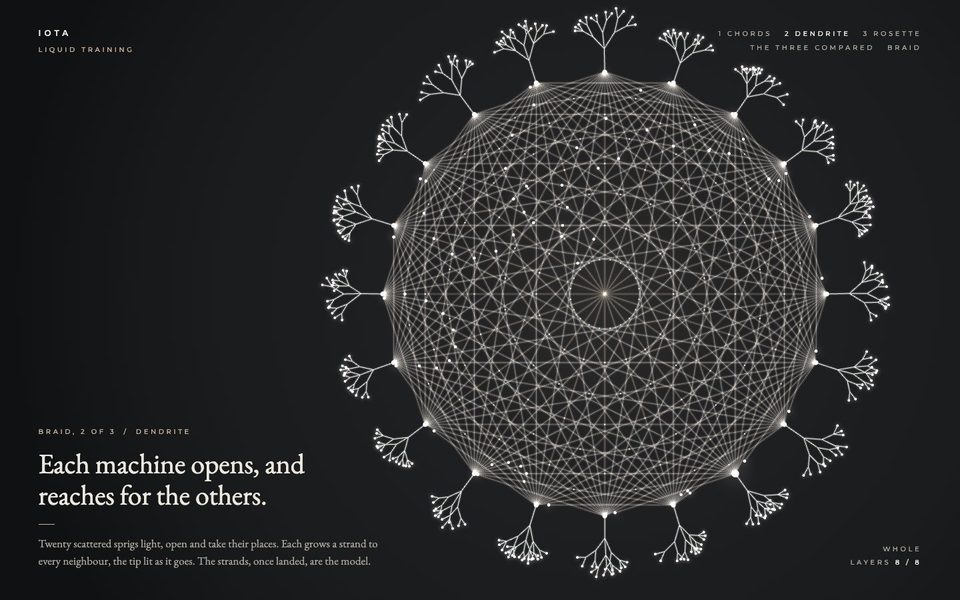
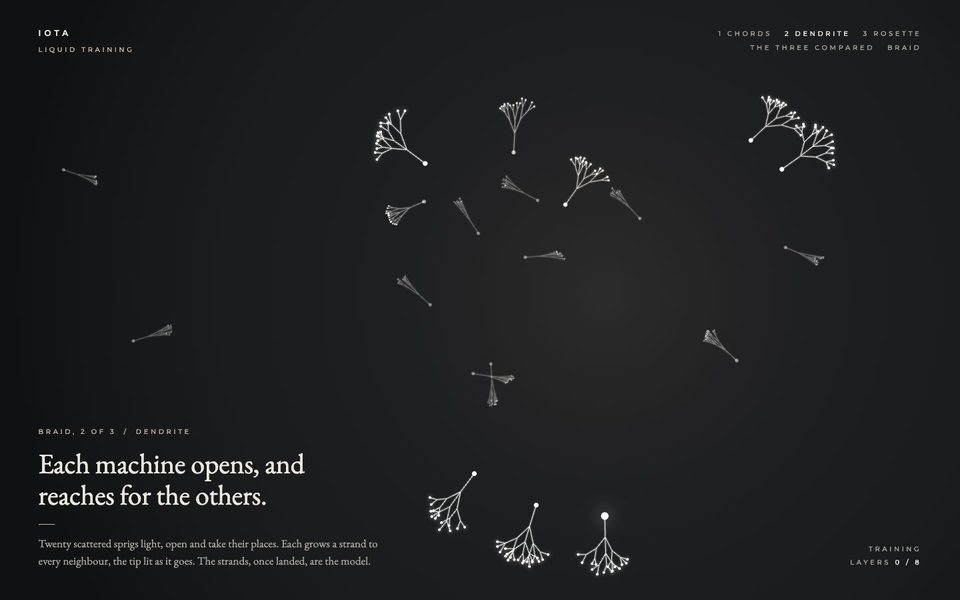
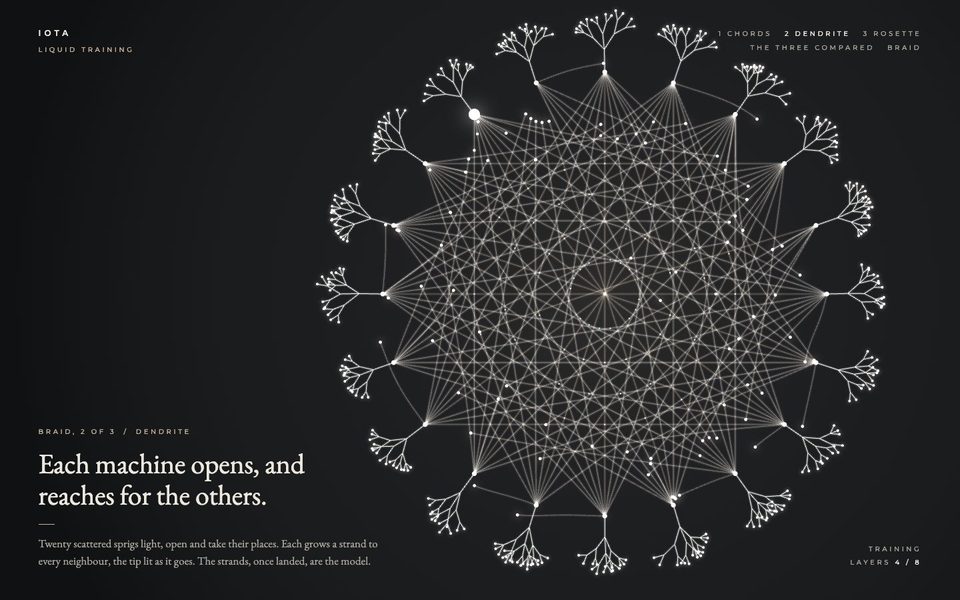
Dendrite: each machine opens, and reaches for the others.

Small branching sprigs adrift; a few have lit and opened
9 s · opening
Sprigs on a ring, strands growing between them with lit tips
15 s · training
The finished figure with a branching sprig at each of the twenty nodes
24 s · whole
From Braid and age1
The most of age1: closed grey sprigs that light, open tips first, and send strands to each other with a lit tip leading. From Braid: the line and the bead of work.
From Macrocosmos
The same figure as Chords, grown instead of pulled. The sprigs stay at the rim, so each machine remains a thing you can see.
Where it falls short
The sprigs make it read as biology (a neuron, a dandelion) more than compute, and the rim is busier than their figure. Braid's loose-strand opening is gone.
Open live →
Permutation 3

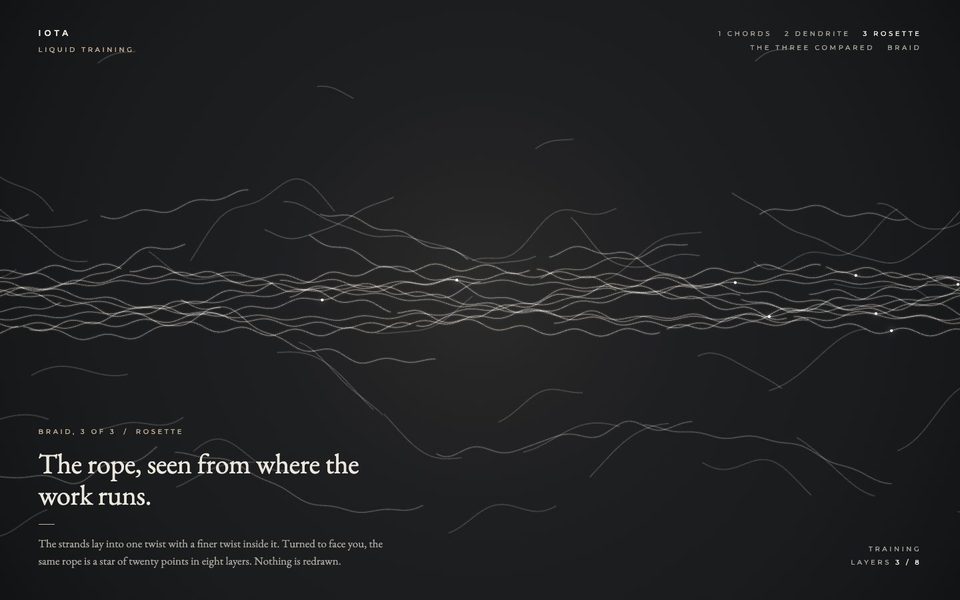
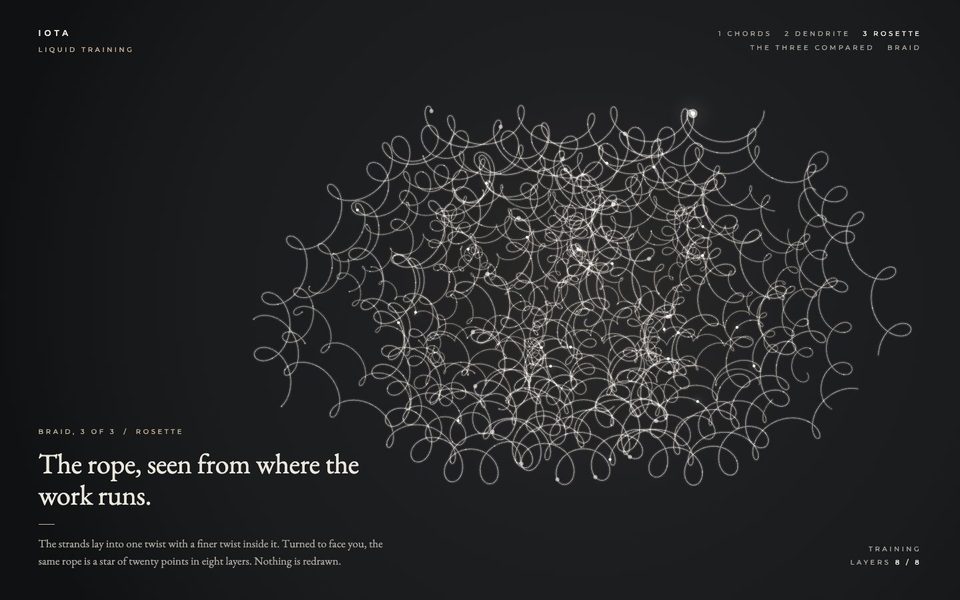
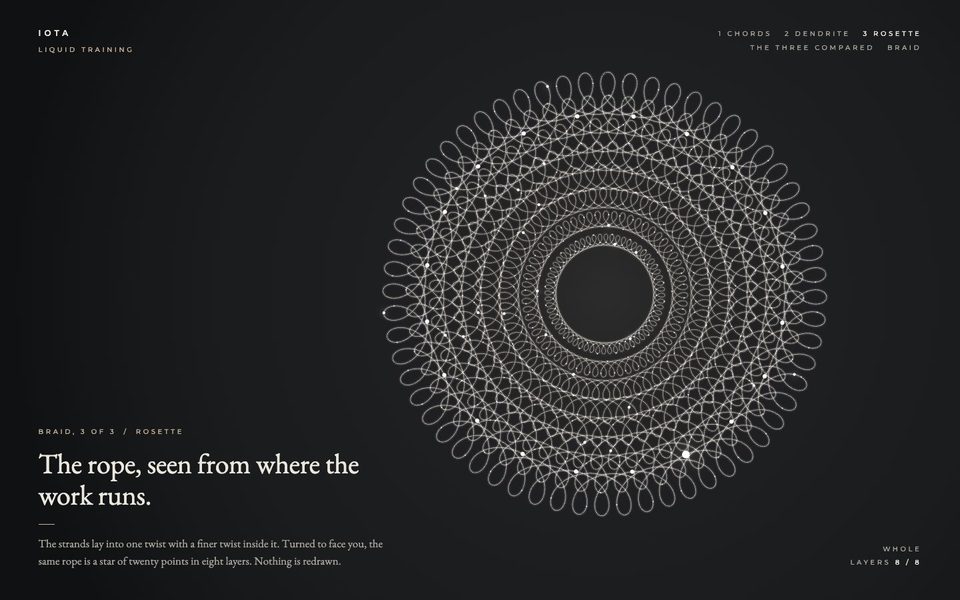
Rosette: the rope, seen from where the work runs.

Loose strands laying into a twisted rope seen from the side
11 s · laying
The rope turning toward the camera, its loops opening
16 s · turning
A radial rosette of eight nested looped rings with nodes
24 s · whole
From Braid and age1
All of Braid: the strands lay into the twist as before. Then the rope turns to face you and opens. From age1, only the idea that the form opens outward.
From Macrocosmos
Radial, eight layers, twenty points to a layer, nodes at the points, one lit. But the lines are loops, not straight chords.
Where it falls short
For a few seconds it is still a literal rope, and the turn passes through a tangle. The end reads as lace or engine-turning more than as their model, and its centre is empty.
Open live →
Permutation 4  ·  after the note on the first three

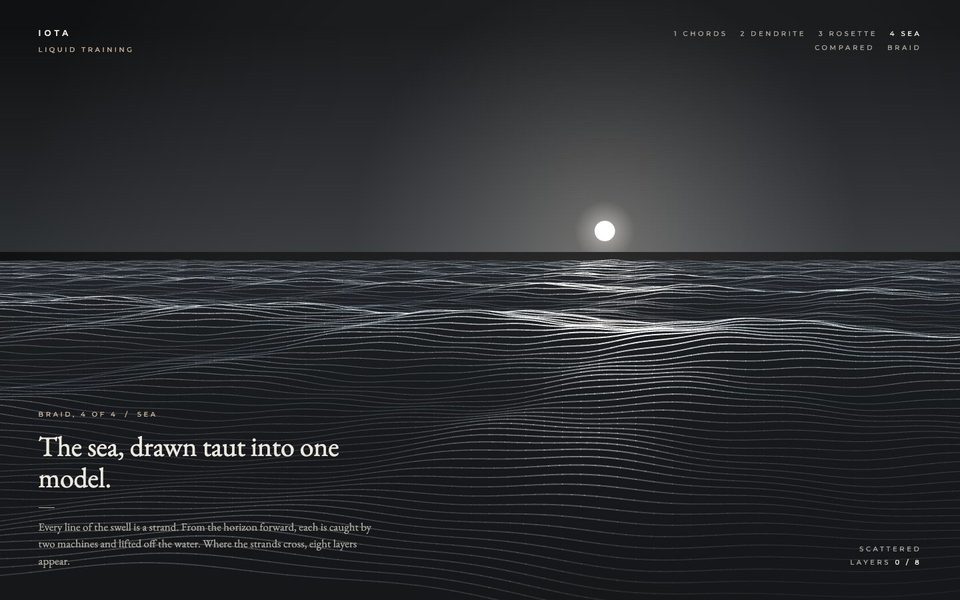
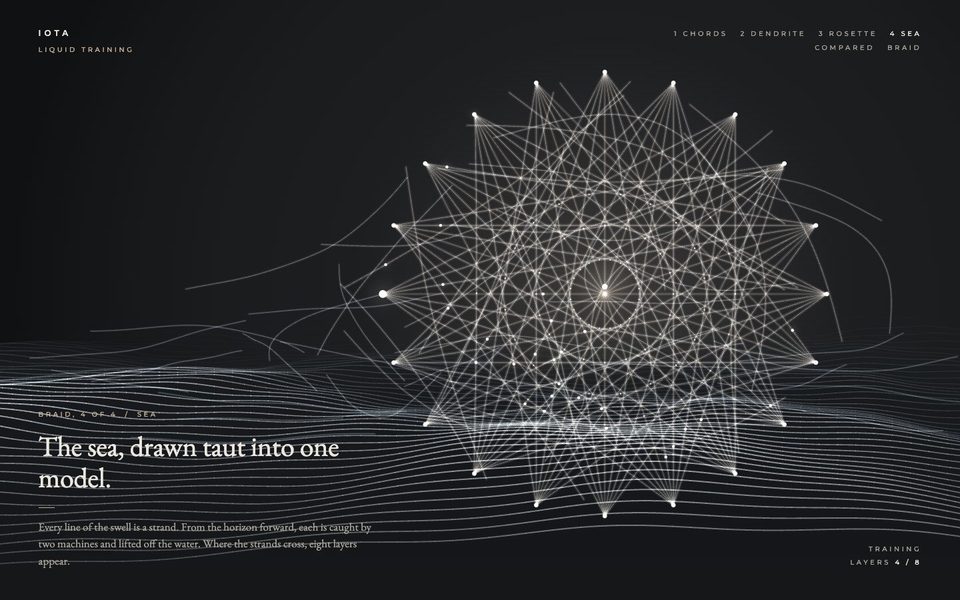
Sea: the sea, drawn taut into one model.

A sea of wave lines to the horizon under a low pale sun
2 s · the sea
Wave lines lifting off the water into a half-formed lattice above it
13 s · lifting
The finished figure of twenty nodes and eight rings
24 s · whole
What changed
Mikyö: the loose strands read as rope or DNA; open on an actual ocean with waves, and let that be what becomes the lattice. The strands are now the lines of a swell, row behind row to a horizon, under a low sun.
How it turns
From the horizon forward, each length of wave is caught by two machines and lifted off the water into its chord. The sun sinks into the centre of the model. On release the strands fall back and are waves again.
Where it falls short
The sea is drawn in line, not photographed: no foam, no depth of colour. Mid-lift, the loose strands above the water still tangle for a few seconds. The finished model keeps no trace of water.
Open live →
Permutation 5  ·  4 October  ·  canonical

W(e)ave: eighty-one threads, woven in their own time.

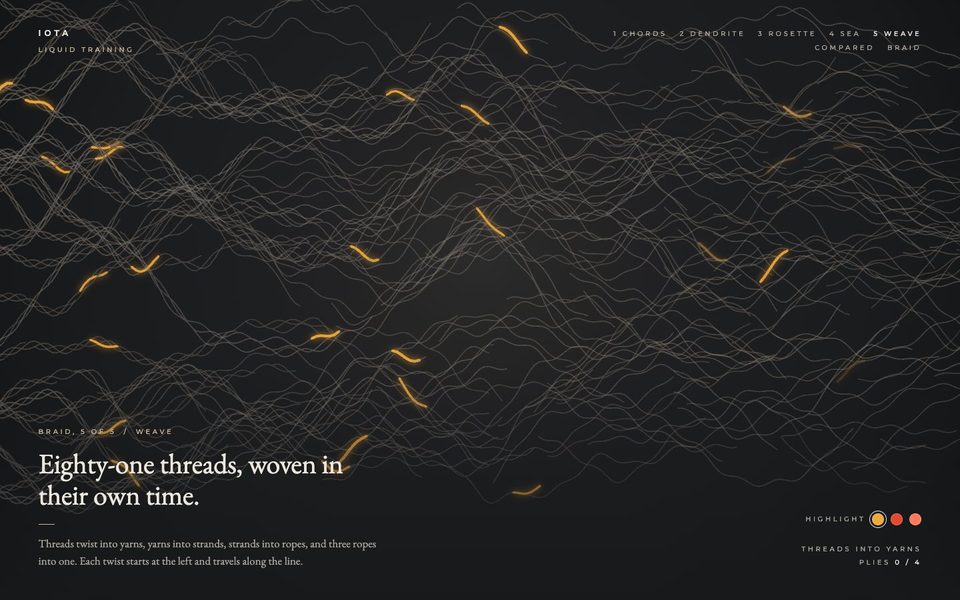
Loose tan threads beginning to twist into yarns from the left
12 s · threads into yarns
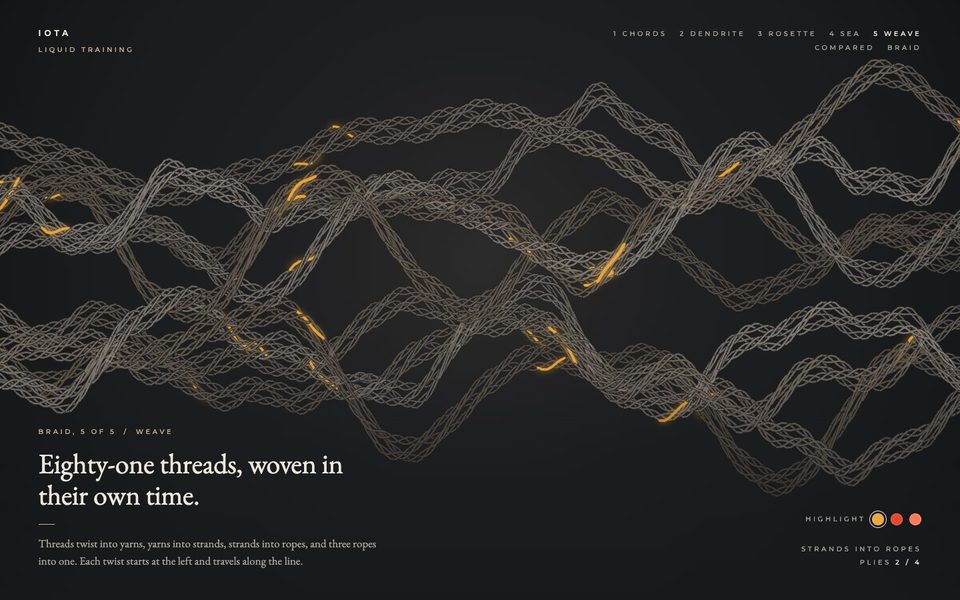
Yarns twisting into nine strands that still wander apart
24 s · yarns into strands
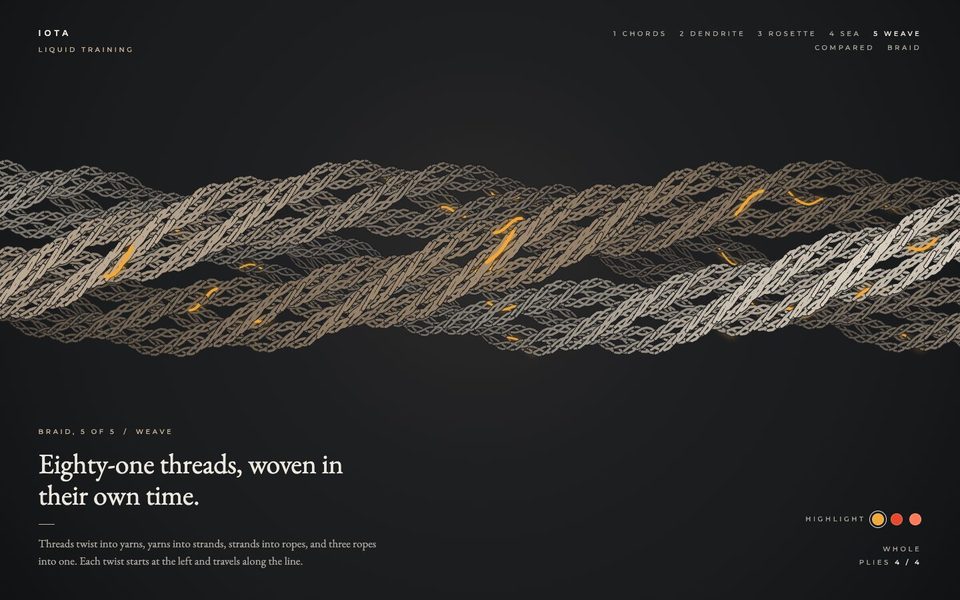
One tan cable of three ropes on dark grey, with red beads
46 s · whole
What changed
Mikyö: a version of the braid that comes together and starts weaving more slowly, not all at once, in the tan and dark grey of the newest pieces, with a red or bright highlight. He named it the one to push forward.
How it weaves
One ply at a time over 56 seconds: threads into yarns, yarns into strands, strands into ropes, three ropes into one. Each twist starts at the left and travels along the line. Three tans, one to a rope. One bead to a yarn in the highlight. Saffron was chosen; vermilion and coral stay switchable to compare.
Where it falls short
It ends as a rope again, the thing the first four moved away from, and it does not become the layered model. The middle stages cross the headline on a narrow screen.
Open live →