| IOTAMacrocosmos · Bittensor subnet 9 | For comparison | Incentivised Orchestrated Training Architecture: a model cut into pipeline slices, each slice on a GPU Macrocosmos does not own; validators score each miner's work and the chain pays miners in alpha. The Orion runs used provisioned and supplier GPUs; Train at Home is the open pool.verified | Pipeline-parallel across single GPUs, 16 stages and 3 replicas at 100B. An orchestrator assigns slices; validators score each miner's forward-pass work, and miners are paid in alpha by score share over a rolling window of about a day, with a cap and the excess burned. Control is central, the data path is peer to peer (Iroh since v3.0.0, 9 March 2026). The open way to join today is Train at Home on an Apple Silicon Mac with 16 GB; the GPU miner repository still lists 16 GB of VRAM. Runs survive nodes leaving; the second 16B run is the repeatability claim.verified | Largest model Orion-100B, the same run: 100B dense, 1.1B tokens, a system-viability proof with no checkpoint offered.
Largest run outside one reserved cluster Orion-100B: 100B parameters, 1.1B tokens, 48 non-colocated A100 80GB across five US datacenters, "provisioned from multiple providers" (unnamed), about two days, 30.8% average MFU, 65% of co-located speed, $20 a replica-hour; a viability run, stopped for cost. Orion-16B: 256 GPUs at launch (27 July), c.180+ (5 August), 225 across three continents (20 August), then a mixed roster of 4090s, 5090s, A100s, L40S and A6000s, finished 23 September; GPUs from "independently operated suppliers", one named (Green Compute); 100B tokens by 14 August, about 20% MFU. How Orion suppliers were paid is not published. No checkpoint offered for download. | The iota SDK and Liquid Compute, announced 28 September 2026: early access by registration, the SDK page still "coming soon". Will Squires says the SDK covers pretraining, RL and fine-tuning; published results are on the legacy code base. Today the door is a managed route ("You own the outcome. We run the training"), by contact form, no pricing. The site also names GPU operators with idle capacity as SDK users. No named paying customer as of this page. Funded by emission and OTC alpha sales; Stillcore Capital invested in SN9 in May 2026 (secondhand, terms unknown). 164 companies in conversation was said from the Exploit stage and is secondhand. | No named paying customer as of this page. Miners are paid in alpha by score share over a rolling day; Train at Home pays out about every 24 hours.verified | No priced round published. OTC sales of owner alpha since June 2025 (stated); Stillcore Capital invested in SN9 in May 2026, terms unknown.secondhand |
|---|
| Covenant AITemplar, Basilica, GRAIL · left Bittensor April 2026 | Rival for the buyer | "Incentivized Internet-wide AI training" (tplr.ai). Ran Bittensor subnets 3, 39 and 81 until 9 April 2026; SN3 is now Teutonic, SN39 is deprecated, SN81 is another team's. Now an independent lab with a GPU cloud, Basilica, paid in TAO.verified | Data-parallel, full replica per peer (8 B200-class GPUs), SparseLoCo compresses updates 146x. Gauntlet scores each peer's update by loss before and after. Pipelining across peers tested at 1B; a 30B pipelined test ran 4 to 14 September 2026 and has finished.verified | Largest model Covenant-72B, the same run: 72B dense, about 1.1T tokens, weights public.verified
Largest run outside one reserved cluster Covenant-72B, 1.1T tokens, 70+ permissionless peers at 8x B200 each, about 94.5% compute utilization, released 10 March 2026. Weights public.verified | Basilica: GPU rentals paid from TAO credits; a multi-node training deploy on rented A100 and H100 (since May 2026); a managed RL post-training API in SDK beta (since 27 August); RL rollout sessions with per-token cost. No public price list. Templar is dormant. No pretraining run can be bought.verified | None public.unknown | No round public. No token; ran three subnet alpha tokens until April 2026. 11 to 50 staff on LinkedIn.unknownStaff count from an aggregator, not re-read. A different company named Covenant (legal AI) raised in September 2026; unrelated. |
|---|
| Prime IntellectHosted RL · GPU marketplace | Rival for the buyer | "The Open Superintelligence Stack": compute, training, inference and sandboxes. The decentralized runs were 2024 and 2025 research, and the peer-to-peer protocol repository is archived; the 2026 business is hosted RL and a GPU marketplace.verified | Data-parallel DiLoCo (each node a full replica, int8 pseudo-gradients, 400x less traffic) on H100 nodes from 30 compute providers. TOPLOC verifies RL rollouts from untrusted workers, not training. No decentralized run to join today.verified | Largest model INTELLECT-3, a 106B mixture-of-experts with 12B active parameters, post-trained from GLM 4.5 Air with supervised fine-tuning and large-scale RL on 512 H200s across 64 nodes in one cluster, about two months; released 26 November 2025. Weights open.verifiedOne cluster, not a distributed run. The largest run outside one reserved cluster remains INTELLECT-1 at 10B.
Largest run outside one reserved cluster INTELLECT-1, 10B, 1T tokens, up to 112 H100s across three continents, 36 to 41% MFU, November 2024. Weights public. Its largest run outside one reserved cluster; INTELLECT-3 ran on one cluster.verified | A training run can be bought today, self-serve: Lab hosted RL post-training (LoRA on open models up to 35B-A3B, priced per million tokens; full fine-tuning in closed beta), GPUs on demand from 50+ providers (H100 $2.43 an hour, spot $0.94, as displayed on the home page), reserved clusters with idle-hour resale, inference, sandboxes. No pretraining offer.verified | Ramp (Series A post and case study); Zapier (TechCrunch and case study); Flapping Airplanes (TechCrunch); Goodfire (case study). A Mixedbread case study says it used prime-rl, the open library. "Over 6k customers" and "over $100m in annualized revenue", by the company. | $130M Series A, 8 July 2026, led by Radical Ventures with NVIDIA, Intel, Dell and Iconiq (own post and TechCrunch); over $150M total; $1B valuation (press). No token. San Francisco. |
|---|
| GradientsRayon Labs · fine-tuning | Rival for the buyer | Fine-tuning as a product: text (instruct, DPO, GRPO) and image jobs by UI and API, "pay for what you use"; miners compete with training code in tournaments of three types (text, image, environment), each opening on Mondays.verified | Training subnet, post-training only. Miners submit code; validator trainer nodes run it on 1 A100 up to 8 H100. Customer jobs run on Runpod by default since April 2026. Emission 1.33% (taomarketcap, block 9171075, 29 September 2026).verified | Largest model No model of its own. Sells compute or fine-tuning; see the run field.verified
Largest run outside one reserved cluster Fine-tunes up to 70B-class models per job; no pretraining. About $100 small, $250 at 20B, $500 at 70B (secondhand); another record cites $10 to $50 an hour.secondhand | Fine-tuning jobs by UI and API, pay per use; the price table is rendered by script and still did not load on 29 September.verified | None named. 3,000+ paying users, secondhand.secondhand | Emission-funded plus job fees; Rayon Labs per SimplyTao and the paper's affiliation; site footer reads Grads.secondhand |
|---|
| ChutesRayon Labs · inference, training research | Rival for the supply | Serverless inference for open models, paid per token, on miner hosts inside Intel TDX confidential VMs: H200, B200 and RTX Pro 6000; TEE is required for every deployment since 12 May 2026. Separately, Parallax: its own pretraining runs on rented RTX 5090 hosts.verified | Inference subnet: a miner's score is the seconds its instances were deployed, busy or idle, times a compute multiplier, over one day. Separately, Parallax trains an 8B MoE on rented 8x RTX 5090 hosts, not SN64 miners. Emission 6.0% (taomarketcap, block 9171075, 29 September 2026).verified | Largest model Parallax 8B theta: 7.8B MoE, 1.2B active, trained on FineWeb-Edu; weights public, MIT, tagged research checkpoint, 28 September 2026.verified
Largest run outside one reserved cluster Parallax 8B alpha, 7.8B MoE (1.2B active), 574B tokens on 240 rented RTX 5090s in 30 hosts across 13 countries, 10 to 12 September 2026. Weights public for a later run.verified | Per-token inference (Kimi K2.6 $0.50 in, $2.85 out per million), Plus $10 and Pro $20 a month, private TEE deployments on RTX Pro 6000 at $1.80 an hour plus a $5.40 setup fee. Parallax is not sold.verified | OpenRouter about 8.1B tokens a day, May to August 2026 (Own Your Mind tracking). Chutes states revenue per trillion tokens near $300,000 on 7-day averages (May 2026); no absolute revenue.secondhand | Emission-funded; revenue stated to go to alpha buybacks. Rayon also runs Gradients. Pseudonymous; the founders post names twelve contributors and says it is hiring. |
|---|
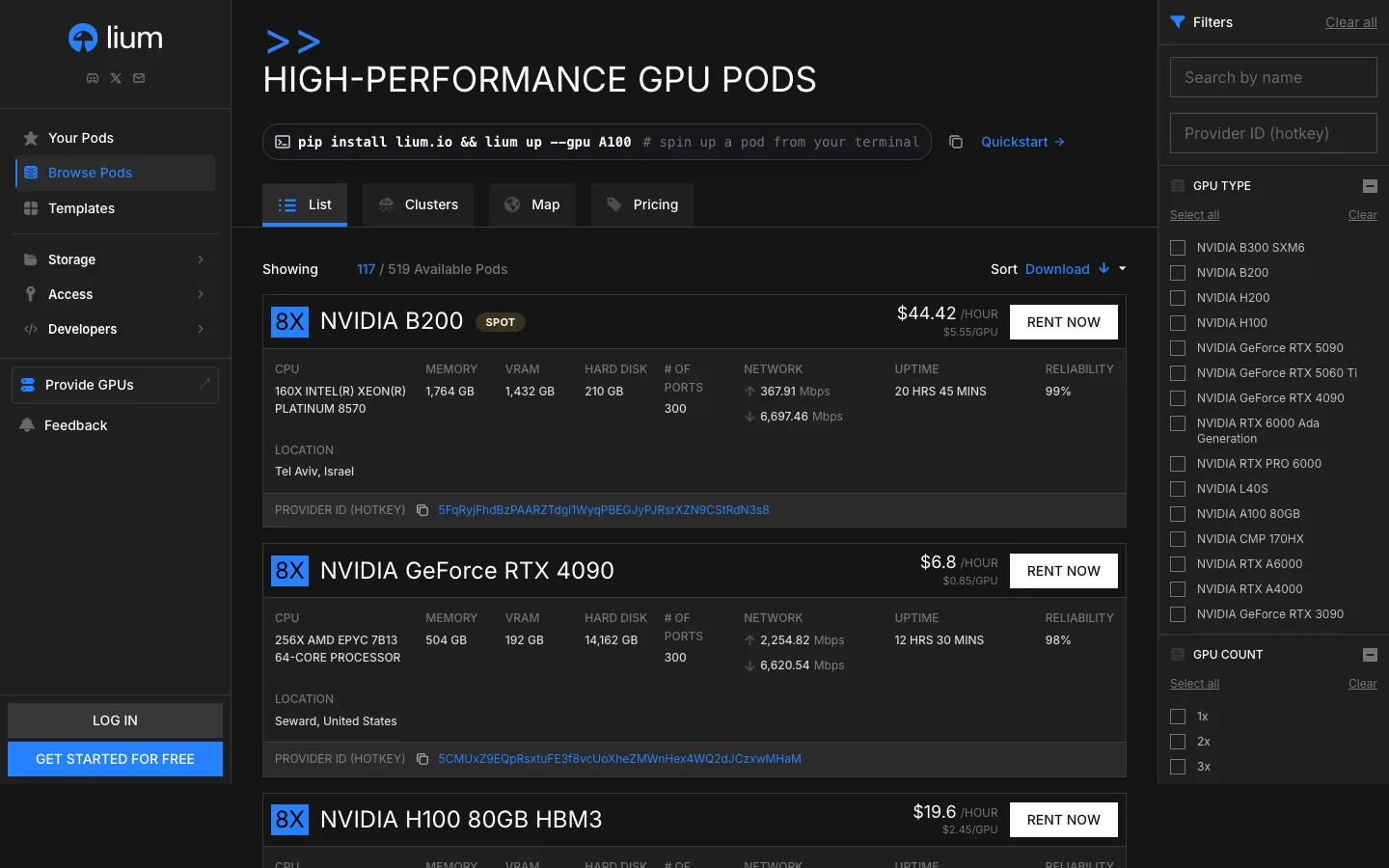
| LiumDatura · GPU rental | Rival for the supply | "A GPU rental marketplace": providers list machines by the hour, renters get pods billed by the second, and multi-node clusters on one fabric (in the CLI and SDK since 15 September; web-only before).verified | Compute subnet. Rented machines are paid from one pool, eligible idle machines from another, while Lium runs its own job on them; idle B300 still $6.40 a GPU-hour (a cut to $1.25 was closed unmerged). 8.1% of TAO-in (chain, 29 September), rank 2.verified | Largest model No model of its own. Sells GPU hours and multi-node clusters; see the run field.verified
Largest run outside one reserved cluster Not a training subnet. Fleet: 1,329 GPUs across 470 nodes (11 September), 4090 through B300; 124 pods and 370 GPUs free on 29 September.secondhand | Hourly pods, asks on 29 September: H200 $3.00, B200 $5.35 to $5.60, B300 $8.50 to $12.95, A100 $1.06, RTX 4090 $0.35 to $0.85, RTX 5090 $0.50 to $1.00 a GPU-hour; spot; clusters. Providers keep 95%.verified | 900 paying accounts and 7,549 rentals in August 2026 (PC Tech); about $432k a month in mid-May (third-party review). Both secondhand; Lium publishes no revenue figure.secondhand | Emission-funded subnet; no round public. Datura AI Corp.unknown |
|---|
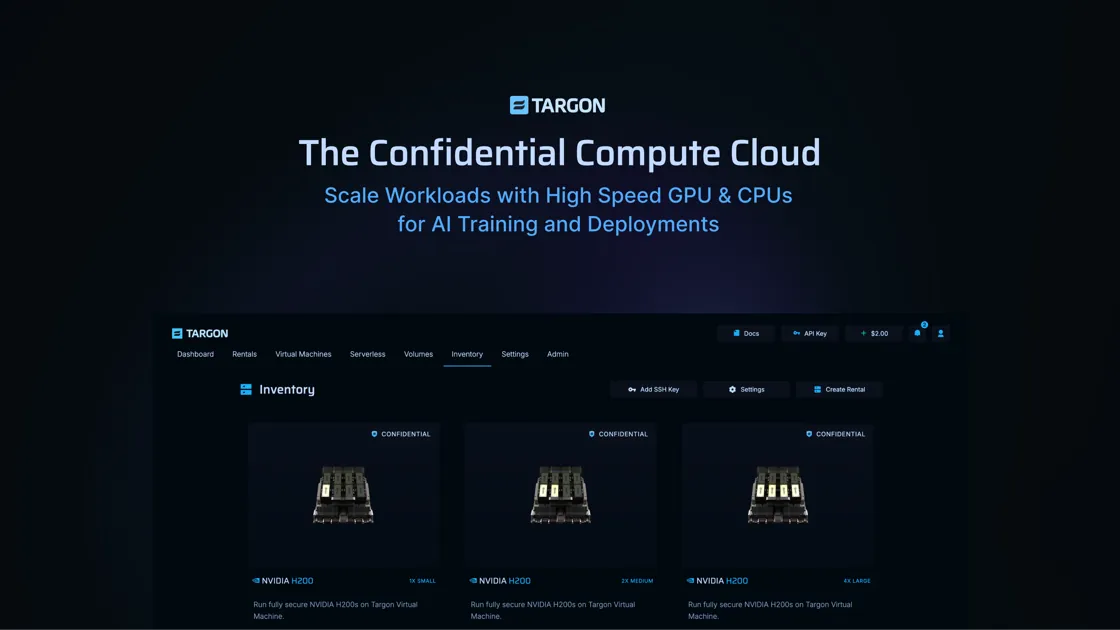
| TargonManifold Labs · confidential compute | Complement | Attested GPU compute inside Intel TDX confidential VMs, plus bare metal (14 September) and sandboxes (23 September), sold "for AI Training and Deployments." Inference now sells as Sybil; the old Targon API returns 410.verified | Compute subnet. Miners install a signed OS on 8-GPU Intel servers, attest every boot, keep cards live; paid per verified card in an auction class whether or not a customer uses it. 4.5% of TAO-in (chain, 29 September), rank 7.verified | Largest model No model of its own. Sells GPU hours; its inference product, Sybil, serves other labs' open models.verified
Largest run outside one reserved cluster Not a training subnet. Fleet: 224 GPUs live in the emission auctions on 29 September (112 H200); "1,500+ H200s" was the Series A claim (July 2025). Utilization unknown.verified | Confidential VMs and sandboxes by consumption: H200 $3.59, B200 $5.35, H100 $3.09, RTX PRO 6000 $1.69 a GPU-hour; B300 $6.50 on manifold.inc, $8.50 on targon.com; H200, B200, B300 out of stock on 29 September. Bare metal: 4x RTX 4090, Austin, $2.00 an hour. Inference via Sybil.verified | "Roughly $10 million in annualized external revenue" (Manifold, 5 June 2026). No named enterprise customer; Bittensor-internal users Dippy, Ridges, Score (secondhand). | $10.5M Series A, 28 July 2025, led by OSS Capital with DCG, Tobi Lutke and others. Austin (secondhand). |
|---|
| Nous ResearchPsyche (NousNet) · DisTrO · DeMo | Reference | An open-model lab that now sells agents. Psyche, renamed NousNet in its repository, is "distributed training of transformer-based AI models over the internet" for "collaboration between untrusted parties"; its optimizer is DisTrO, from the DeMo paper.verified | Data-parallel: every node holds a full replica, in practice a multi-GPU server; DeMo cuts traffic up to two orders of magnitude. Witness quorum on a Solana coordinator; recompute-and-punish described, not confirmed live. Joining needs a binary from the run administrator.verified | Largest model Hermes 4 405B, post-trained from Meta's Llama 3.1 405B, released 26 August 2025, with a 70B and a 14B beside it. The base was Meta's; the post-training hardware is not published.Not a pretraining run. The largest run outside one reserved cluster is Consilience 40B on Psyche.
Largest run outside one reserved cluster Consilience 40B, started 14 May 2025, last public checkpoint step 23,216 on 14 August 2025. Tokens, hardware, sites and MFU not published. Checkpoints public. | Hermes Agent (open source), Nous Portal subscriptions ($0 to $200 a month: inference on 300+ models, hosted agents), Hermes Business and Enterprise (14 September 2026). Psyche compute is not sold; no priced training offer.verified | None public for training.verified | $50M Series A, April 2025, Paradigm, at $1B on a future token (press); at least $75M at $1.5B led by Robot Ventures with USV, in talks July 2026 (TechCrunch; aggregators report it closed, Nous has not announced it). No official token.secondhand |
|---|
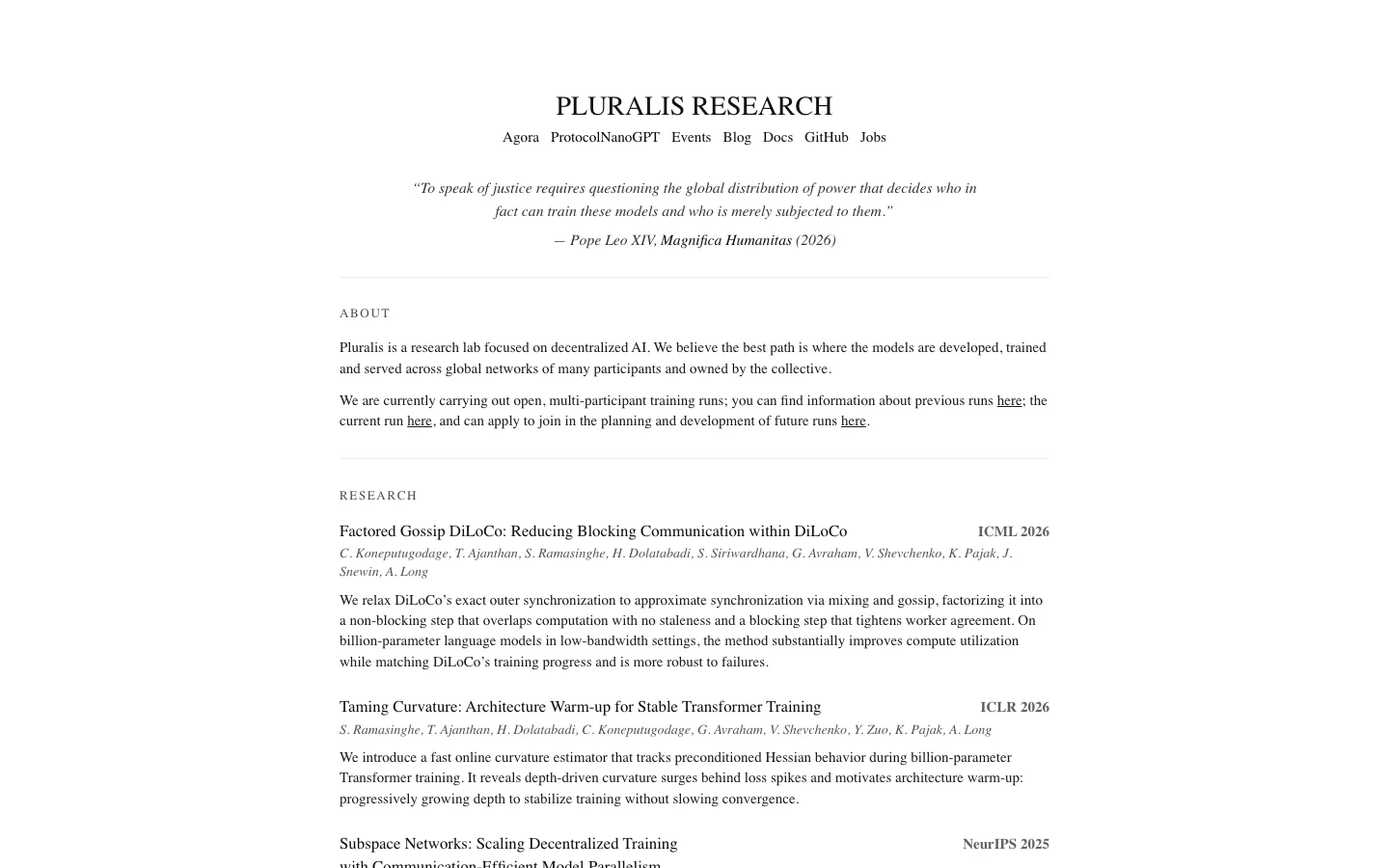
| Pluralis ResearchProtocol Learning · Agora | Reference | "A research lab focused on decentralized AI" whose method, Protocol Learning, trains a model split across many participants so that "no single party ever possesses the complete weights" (Agora paper).verified | Pipeline-parallel across 24 GB cards, one stage per worker, seven stages at 8B; activations compressed up to 100x. Verification is code integrity only. Head, tail and averaging ran on Pluralis nodes.verified | Largest model A 13B systems test, about 1 to 8 September 2026: 1,215 nodes, peak 364, 62.4B tokens, 14.9% MFU. Not a completed model; the largest completed run is Pluralis-8B.verified
Largest run outside one reserved cluster Pluralis-8B, 500B tokens, 330 contributor nodes over 40 days, about 20% MFU, "63% of the efficiency of a centralized H100 baseline" in tokens per pooled TFLOP. Trained 14 May to 23 June 2026.verified | Nothing. Contributors earn points; "there is no financial reward tied to your score at this stage." No token. The homepage application is a community sign-up, not a sale.verified | None public. The only money out is USD 18,000 in ProtocolNanoGPT speedrun prizes.verified | $7.6M seed, March 2025, led by USV and CoinFund (company release). No later round found. About 19 staff.Headcount from Tracxn (secondhand). |
|---|
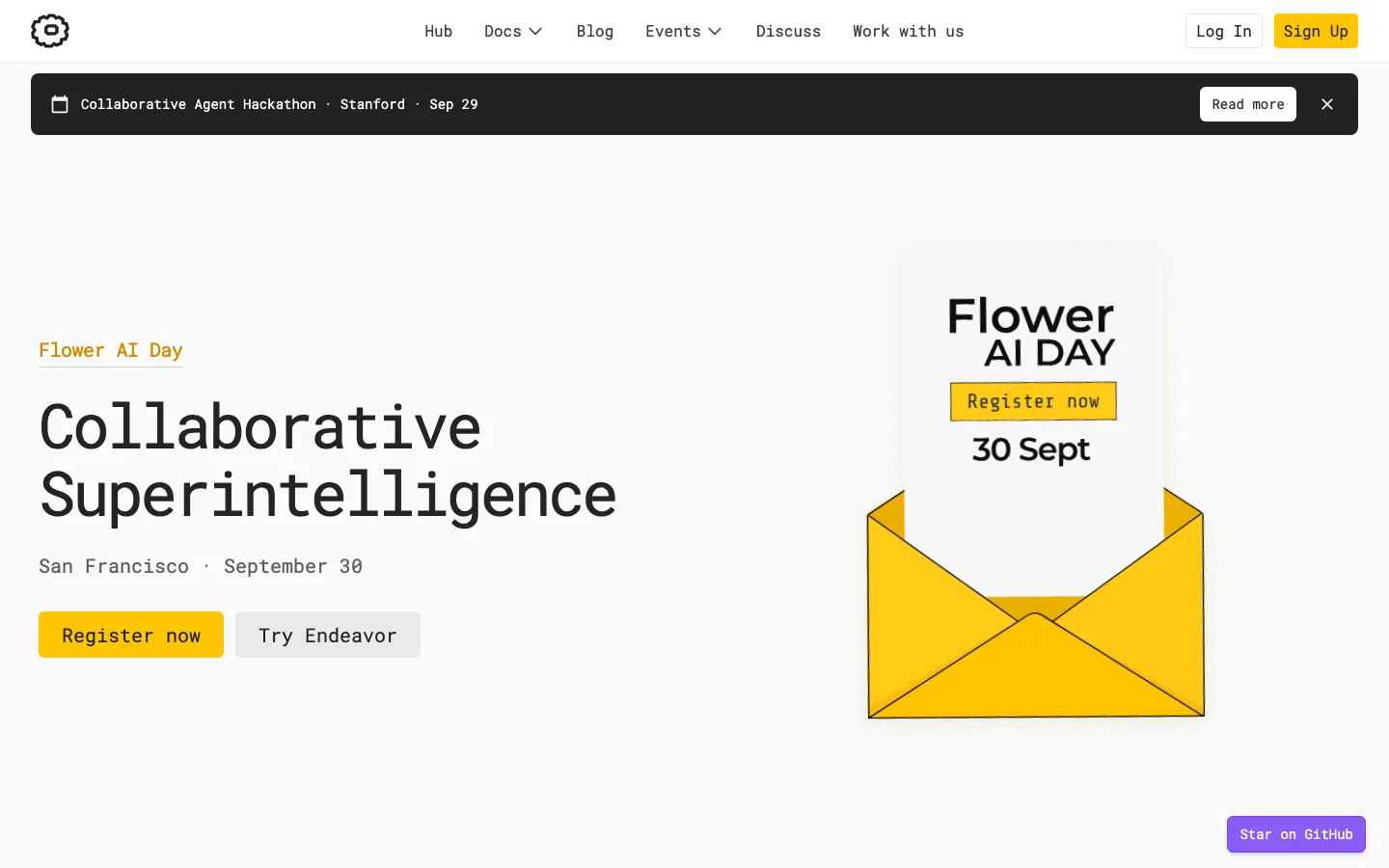
| Flower LabsPhoton · SuperGrid · Endeavor | Reference | The federated-learning framework company. Photon is its federated LLM pretraining system; SuperGrid the managed platform; Endeavor 1.0 (1 September 2026) its frontier model, built by continual pretraining on an open-weight base. | Cross-silo federated: each invited institution holds a full replica and trains on its own data, 64 to 512x less traffic. No verification of updates; trusted consortium only.verified | Largest model Endeavor 1.0, 1 September 2026, 'a frontier-class generalist for reasoning, coding, and long-horizon agent work.' Built on the open-weight ecosystem by continual pretraining and post-training. Parameter count and base model not published; benchmarks self-reported.The largest run outside one reserved cluster is Photon at 7B.
Largest run outside one reserved cluster Photon 7B, four clients at 8 H100 each in Utah, Texas, Quebec and Maharashtra, aggregator in England; 0.65x the wall time of centralized, modelled at 10 Gbps; per-device MFU 0.071. A 13B run is blog-only.verified | SuperGrid: Pro at EUR 20, 50 or 200 a month billed yearly, more with added credits; Max by sales with confidential compute and SOC 2 reports; free accounts get 3,000 sign-up credits. Endeavor as a managed service or private deployment, preview. Lizzy 7B open weights. Pilot Program and forward-deployed engineers. No decentralized pretraining run can be bought.verified | Payment not stated for anyone. Flower's Customer Outcomes page names docport (with AstraZeneca) and PharosAI (NHS biobanks), built with its engineers, and Banking Circle and JPMorgan AI Research, built independently. Tech.eu calls NHS and JP Morgan clients.Tech.eu wording is secondhand. | $20M Series A, February 2024, Felicis; $23.6M total (own post). No later priced round found. No token. London and Hamburg (Tech.eu). |
|---|
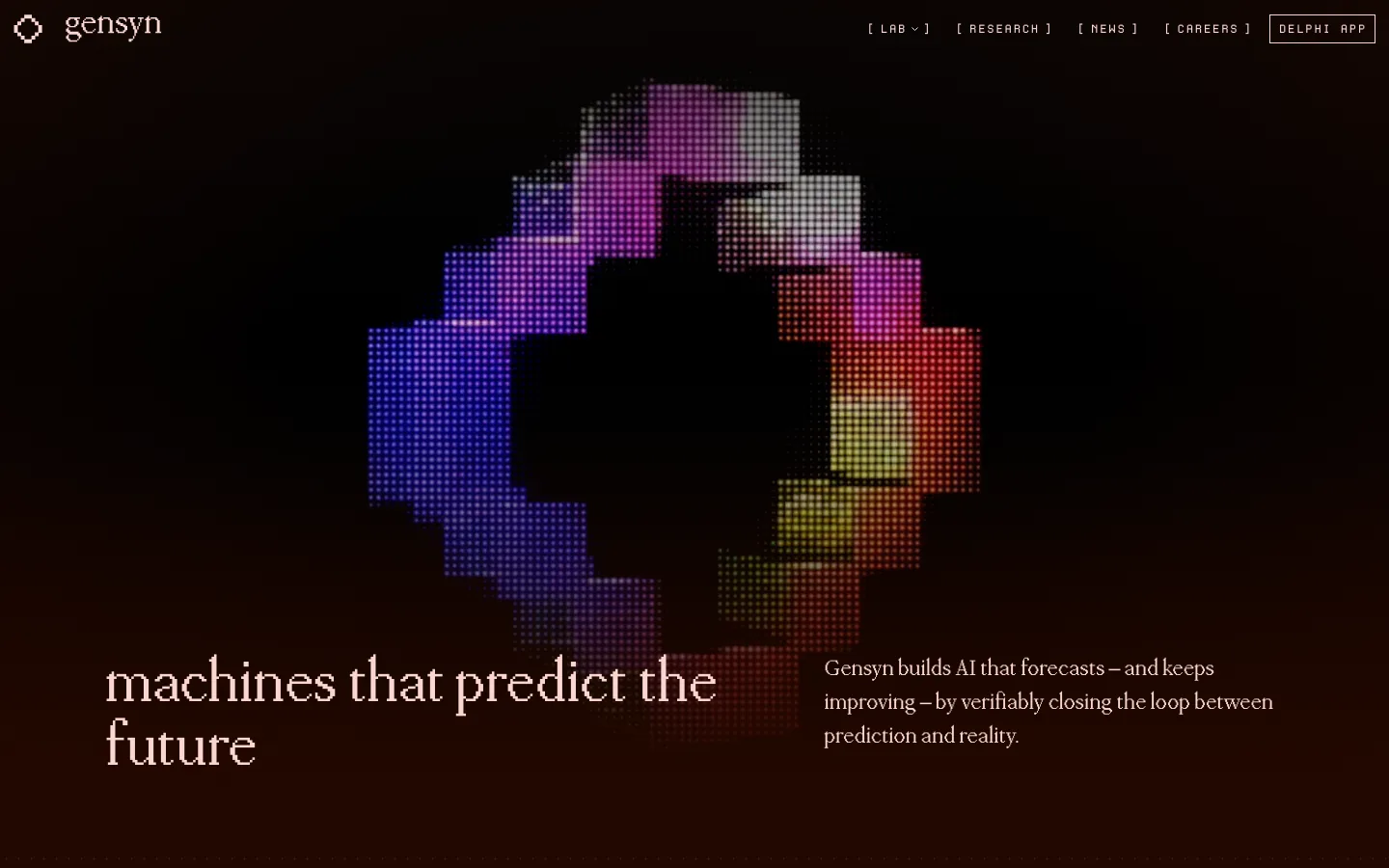
| GensynVerde · open-1b · Delphi | Reference | Once "HTTP for machine learning compute" (co-founders, Epicenter interview); today the homepage says "machines that predict the future" and the live product is Delphi, an AI-settled information market. Four pivots on the public record: ML compute protocol (2022 to 2024), RL Swarm testnet (March 2025), personal-model apps BlockAssist and CodeAssist (2025, now sunset), Delphi (testnet December 2025, mainnet April 2026).inferred | No live distributed training. RL Swarm (data-parallel, each node its own small model) has run no official swarm since January 2026 and is marked paused. Verde and open-1b make every training step bitwise auditable; open-1b ran on 48 H100s across six Google Cloud nodes.verified | Largest model open-1b, 1.61B, the same run: 48 H100s on six Google Cloud nodes, run centrally so that every step could be hashed and audited.verifiedNo run outside one reserved cluster at model scale; RL Swarm trained 0.5B to 1.5B per node.
Largest run outside one reserved cluster open-1b, 1.61B, 400B tokens, 48 H100s on six Google Cloud nodes, 27.8 days of training, about 5% MFU, released 15 September 2026. Weights and every step's hash public. Run centrally, not a distributed run.verified | No training run can be bought; the open-1b harness is "not a general-purpose training framework." Delphi sells market creation and trading in USDC: creators take 1.5% of volume, and a 0.5% protocol fee buys $AI on Uniswap, of which 70% is burned, 29% goes to the Community Treasury and 1% to the caller. Buybacks are live on chain (latest 17 September 2026). Nothing on Delphi requires $AI. REE (SDK MIT, compiler and operator binaries proprietary) and AXL are free tooling.verified | No training customer public. Delphi, 2 September 2026: $250,426 cumulative volume, $76,980 verifiably settled, 26,843 trades by 2,809 traders, 600-plus markets. | About $78M raised since 2020 (The Block, April 2026): seed and pre-seed of $7M-plus, $43M Series A led by a16z (June 2023), $16.7M led by a16z crypto at a $1B fully diluted valuation (October 2025), and an $11.7M $AI token sale (December 2025). $AI distributed April 2026. London.secondhand |
|---|
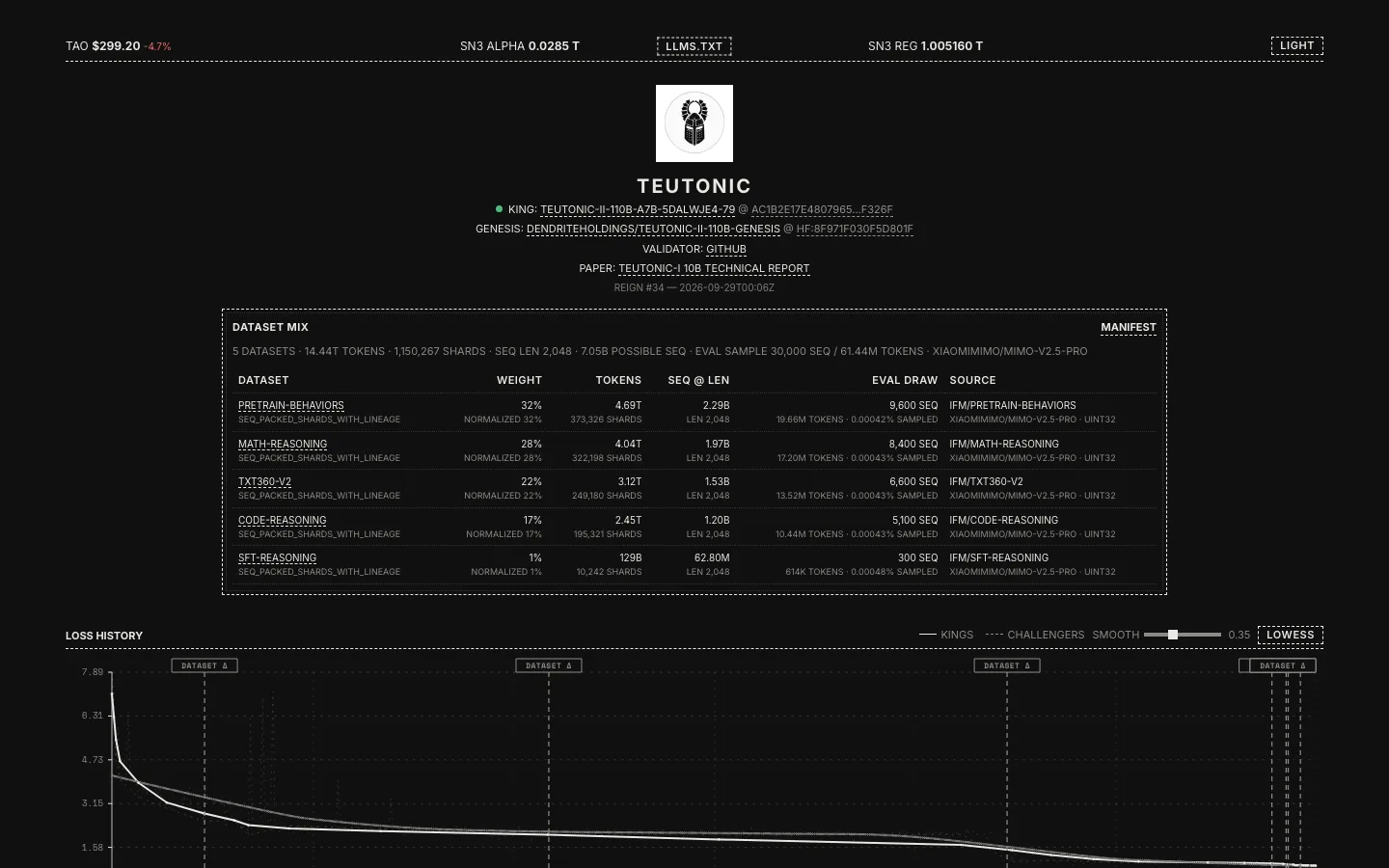
| Teutonicking of the hill · the old Templar slot | Reference | "A king-of-the-hill pretraining system for Bittensor subnet 3": miners upload checkpoints, a validator duels challenger against king, the winner is paid a reign.verified | "Competition parallel": every miner pretrains the king further on its own rented multi-GPU node and uploads a whole checkpoint; nothing is shared. Paired loss duel on held-out text. Emission 2.4% today (aggregator).verified | Largest model Teutonic-II-110B, the same: about 110B total, a MiMoV2-style mixture-of-experts with 256 routed experts, 8 selected per token, about 7.3B active. The genesis checkpoint is random weights, not a pretrained base.verifiedHugging Face model card, dendriteholdings/teutonic-II-110B-genesis, read 29 September 2026. One shared expert per MoE layer as well.
Largest run outside one reserved cluster Teutonic-II-110B: 110B MoE (about 7.3B active), trained by rival miners one checkpoint at a time; not one shared run. Duels since 24 August 2026; 34 coronations by 29 September, lately about one a day. Tokens, hardware and MFU unknown by design.verified | Nothing. Every king is free on Hugging Face; miners are paid in SN3 alpha.verified | None public.verified | Emission-funded. Dendrite Holdings lists Teutonic as "developing" and says it co-created SN3 in 2026.inferredDendrite listing verified on dendrite.holdings, 29 September 2026; emission-funded is inferred, no other revenue found. |
|---|