The landscape around IOTA
Forty-three other ways to train a model or put a GPU to work, laid out by where the compute comes from and what you get. IOTA is built for one corner: training one model across machines nobody reserved.
Where your model could train
Capacity the seller runs · A training run
They train it for you
Per 1M training tokens, 8B model

Machines nobody reserved · A training run
One model across machines nobody reserved
Nobody sells this yet. IOTA has announced it.

Capacity the seller runs · Machines: you run the job
You rent their machines
Per H100-hour
Machines nobody reserved · Machines: you run the job
You rent idle machines
Per H100-hour
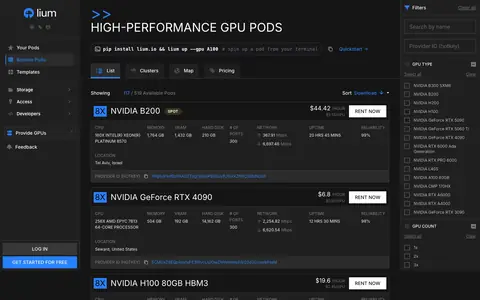
Not selling to a builder

Where your card could earn
Data-centre GPUs only · Trains a shared model
Data-centre cards, one shared model
No one open today
Your own card: a gaming GPU or a Mac · Trains a shared model
Your card trains a shared model
Paid in a token or points; no figure per card yet
Data-centre GPUs only · Rented out, or serves jobs
Data-centre cards, rented out
A gaming card cannot join
Your own card: a gaming GPU or a Mac · Rented out, or serves jobs
Your card is rented out
What one RTX 4090 brings in a day
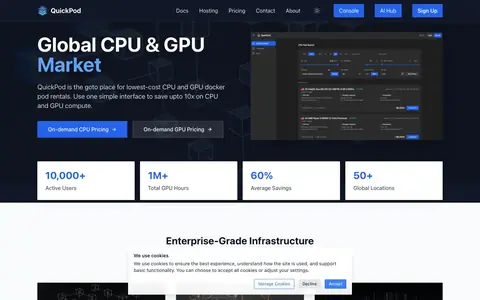
Doors that do not pay for a card's hours
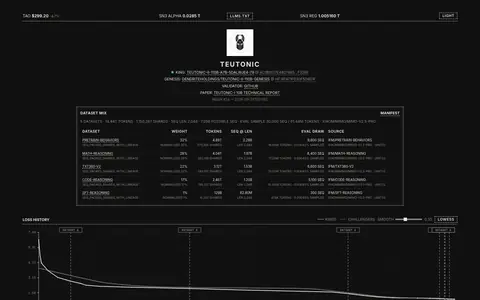
Each tile is that name's own homepage, captured 28 Sep to 16 Oct 2026. Tap a tile for everything on it; press + to put it beside IOTA.
Side by side
IOTA beside any two, for a model to train
The side-by-side view needs JavaScript. The board and the record read without it.
One card per name. Figures are the same ones in the tables below: read 3 to 4 Oct 2026, daily earnings at full occupancy by arithmetic, IOTA's two figures taken from its stage deck.
Two prices everyone can check
What a job costs, what a card earns
A team with a model to train
One fine-tuning job
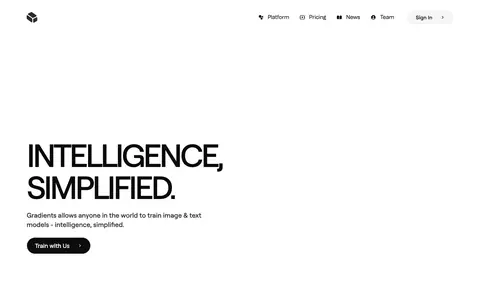 Gradients (SN56)price not readable
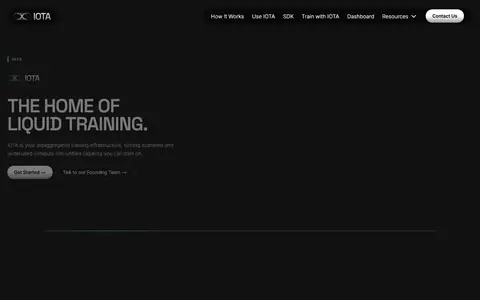 IOTA (SN9)no price yet
30M training tokens on an 8B open model: the public price per million, times 30.
Someone with a GPU
One RTX 4090, one day
IOTA (SN9)no figure publishedThe door's published rate times 24 hours, the best case. Most pay a token, not dollars.
About the fieldHow the page sorts it, what IOTA inherits, the rules
Open
How the page sorts the field
Three questions put to every alternative. Does it reach machines nobody reserved: idle, scattered, mismatched, free to leave? Does it train one model across them, so the run survives the machines? Can a builder buy that today? The grouping is this page's reading of the rows below.inferred
Each runs the job on capacity it controls. Gradients runs miners' code on its own trainer nodes of one A100 to eight H100s. None of the pages read describes a run across outside or interruptible machines.1356465
Multi-node training inside one matched cluster. The builder reserves or rents the cluster and runs the job.666718
They reach idle and individually owned cards and rent them one machine or one cluster at a time. The builder gets machines, not a run: an interruptible instance pauses when it is outbid, and the job pauses with it.6813363569
Each has run a model across machines it did not reserve. None sells it: Templar is dormant, Pluralis and Nous sell nothing, Flower sells a framework subscription, and Prime Intellect's runs since late 2025 are single clusters.70717273585960
The stage deck's own words (p. 15): "Fragmented, interruptible compute that trains like a centralised cluster. Drop-in for PyTorch." Three mechanisms on p. 16: mismatched hardware in one job, nodes that drop and rejoin mid-run with training continuing at an 80% quorum, and orchestration built into the SDK. Orion-100B ran this way on 48 A100s. The SDK is a registration form; private beta in October.11127475
On these rows IOTA is the only one that offers, as a product, to train one model across machines nobody reserved. The offer is announced and not yet open. The others either sell training on capacity they control, rent idle machines without the training, or have shown the training without selling it.inferred
The choice a model builder makes
A model builder chooses between three things. A reserved cluster: matched hardware, held for months, the highest price. Spot: whatever is free, taken back without notice, the lowest price. Or a swarm: heterogeneous compute the builder does not own or reserve, joined and left mid-run, with the run surviving the machines. Every project on this page sells or studies the third.
IOTA's mechanism, in one sentence: a model is cut into pipeline slices, each slice runs on a GPU Macrocosmos does not own, validators score each miner's work, and the chain pays miners in alpha by score share over a rolling day; the subnet has been on mainnet since June 2025 (relaunched August 2025). The difference from the field is the unit of payment (scored work on one slice, not a whole checkpoint or a trusted node) and the shape of the parallelism (pipeline across single cards, not data-parallel copies of a whole model).
The four relations in the profiles
- Rival for the buyer
- Sells today, or on a stated date, a runtime, a managed run or capacity that a model builder without a reserved cluster would buy instead of IOTA's SDK or managed route. Pretraining, fine-tuning and RL all count; IOTA pitches all three. Raw GPU hours count only weakly.
- Rival for the supply
- Recruits the same class of card IOTA runs on (Apple Silicon Macs, 24 to 32 GB consumer GPUs, single A100, L40S or A6000 cards), and the owner must choose: the card earns from one or the other. Sharing TAO emission is not supply rivalry.
- Complement
- Has a concrete path to buy from IOTA, sell compute to it, or distribute it. The card names the path. None of these paths is a public arrangement unless the card says so.
- Reference
- Lineage, a benchmark or a competing claim: IOTA inherits from it, is measured against it, or is compared with it. It has no offer a builder could buy instead of IOTA and draws on no shared supply today.
What IOTA inherits
- SWARM Parallelism, 2023Ryabinin, Dettmers, Diskin, BorzunovTemporary randomized pipelines over preemptible T4s at 200 Mb/s, rebalanced on failure, trained a 1B shared-parameter model. IOTA's nearest ancestor. IOTA adds a central orchestrator that assigns, scores and pays on chain. source
- Petals and Hivemind, 2020 to 2022learning-at-home; Borzunov et al.Volunteer machines found over a DHT; Petals served and fine-tuned BLOOM-176B by splitting layer blocks across consumer GPUs. The same shape as IOTA's slices, with trusted peers and nobody paid. source
- DiLoCo, 2023; Streaming DiLoCo, 2025Douillard et al., Google DeepMindData-parallel replicas take many local steps and sync through an outer optimizer, matching synchronous training with 500x less communication; streaming subsets cut bandwidth two more orders. The method behind Prime, Nous, Covenant and Flower. IOTA shares the slow-links premise, not the data-parallel shape. source
- DeMo, 2024Peng, Chen, Su, Quesnelle, Kingma, Liu (Nous)Decoupled momentum with a sparsified transform sends up to 85x less data per GPU than AdamW-DDP at 300M to 1B. Compresses gradients between replicas; IOTA compresses activations between slices. Different bottleneck, could stack. source
- Decentralized training in heterogeneous environments, 2022Yuan et al.; Together's foundersScheduling for geo-distributed runs across three continents, 4.8x over Megatron. The academic root of the whole field; the company now sells clusters. source
- Nemotron-4 340B across two sites, 2025NVIDIA3,072 GPUs in Chicago and Ashburn, about 1,000 km apart, one synchronized gradient reduction across sites, over 96% of single-site efficiency. Cross-site training in production: a full cluster at each site and only gradients on the wire. source
- DiLoCoX, 20250G Labs and China MobileA modified Qwen1.5-107B for 4,000 steps on 160 A800s in 20 nodes, with the 1 Gbps link emulated in software; 0G calls it a proof of concept. The pipeline cuts stay inside trusted 8-GPU nodes; the 107B figure is not an open run. source
Considered for a profile and left out
- Affine, SN120A teacher-anchored distillation contest, not distributed training: each miner fine-tunes its own model to match a frozen teacher; nothing sold. The operator rents Lium pods to serve the leading model. Steeves matters as a person and is on the Teutonic card.
- Swarm, SN124Drone flight policies, one per miner, trained locally and scored in simulated worlds; no LLM, no compute sold, no fleet. A €370k raise and a solar-park pilot, secondhand.
- Bagel LabsNow a physical-AI lab. Paris (2025) trained 8 isolated experts with no communication on clouds it rented (AWS, GCP, Runpod, local); no network, nothing sold; Bakery is offline. Toronto; $3.1M pre-seed (2024), secondhand.
- EXO LabsLocal inference on devices you own, sold to businesses as deployments; no training product. Training work is small-cluster and simulated research (SPARTA, 124M, up to 8 nodes; EXO Gym idle since December 2025). No open network.
- io.net, Akash, Hyperbolic, Aethir, Render, TogetherNone trains one model across machines it does not run as one cluster. Akash, Hyperbolic, Aethir and Render rent GPUs and the customer runs the job. io.net (Training as a Service, beta) and Together sell managed fine-tuning on a rented cluster, not pretraining. They rent out other people's hardware. Each is on this page as a card, with its price or pay.
- ChronoLLM SN38; SN39, Basilica's former subnetSN38 is ChronoLLM: miners train whole models with a date cutoff and a validator duels them; not distributed training, nothing sold. Emission 3.9% today. SN39 has been deprecated since Covenant's April exit and carries no emission; Basilica now runs off-chain and is on the Covenant card.
- FLock.io, HyperspaceEach participant trains a full small model and shares updates: FLock averages them with stake-weighted votes and collective slashing; Hyperspace's largest run was a LoRA fine-tune of Qwen2.5-0.5B on 32 nodes (14 Apr 2026), paid in points.
- Fireworks, Alibaba RollArtBackpropagation on one matched cluster; only RL sampling spreads across regions or GPU types; no outside machines.
- 0G Labs, Ambient, Yotta Labs0G's 107B run was a consortium proof of concept (in the references); Ambient's training is a design on testnet; Yotta has a scheduler and no run.
- Federated learning (Gboard, Apple, NVIDIA FLARE, Owkin)Small models or fine-tunes on known devices or partner institutions, for privacy, not pay. Flower is on this page.
The claim most likely to be disputed
Most likely to be raised by either team. Which run is the largest. By tokens, Covenant-72B: about 1.1 trillion against Orion-100B's 1.1 billion. By dense parameters, Orion-100B (Teutonic-II has 110B total but is a mixture-of-experts with about 7.3B active, trained one checkpoint at a time). Covenant-72B was a completed permissionless pretraining run; Orion-100B was a viability run on 48 provisioned A100s, stopped for cost; Orion-16B is the run Macrocosmos has said will be open to outside miners (stated in its launch thread; not yet shown on the record). The Covenant-72B paper (arXiv 2603.08163, 1.09T DCLM tokens plus annealing) beside the Orion-100B write-up (1.1B tokens, stopped for cost). Both numbers are on the page; the page says which is which.
How a name is added
An entity is added when it meets the inclusion rule and a primary source (its own docs, paper, repository, or announcement) can be opened for its mechanism. Every card carries the same eight fields. Every cell is filled or marked unknown. A company is never called a customer, partner, or pilot of IOTA unless Macrocosmos has said so in public.
Mechanism and runs are taken from primary sources only. Funding and headcount may come from aggregators or press, labeled.
The page is rendered by tools/render_scape.py from two files: field.json for the profiles and the competitive-set data for the alternatives. The public copy of both is landscape.json. Fork the data. Send corrections to connect@mikyo.one and they go in with a date.
- An entity is in if it trains one model across machines that are not run as one cluster and exchange updates during the run, sells such a run or a runtime for one, or is a Bittensor subnet that pretrains a language model from scratch or sells compute or training. Pure inference marketplaces are out unless they have announced such training.
- Relation is judged against the buyer IOTA names (a model builder without a reserved cluster, for pretraining, fine-tuning or RL) and the cards IOTA runs on (Train at Home Macs, consumer GPUs, single datacenter cards), as of 29 September 2026. The tests are in the four relations above.
- Funding and headcount come from the 6 September 2026 landscape scan (`landscape/decentralized-ai.csv`) unless a card gives a newer source. They are aggregator or press figures and are labeled so.
The labels
- verified
- checked against the code, a paper, the chain, or a live page, on the date given
- stated
- the project said it, in the source given
- secondhand
- reported by someone else; not said by the project in writing
- inferred
- reasoned from stated facts; the reasoning is given
- unknown
- the public record does not fill this cell
Six search angles, 240 claim rows from 169 sources, 24 load-bearing claims checked by three independent verifiers each: 24 confirmed, none dropped. The verifiers confirmed that each source says what is claimed; most did not search for a contradicting source. Every daily earnings figure is arithmetic from a published rate, at full occupancy.
The full recordEvery table, every name's rows, every source
Open
Fine-tuning an open model
Public price to fine-tune an open model of about 8B parameters, per 1M training tokens, read 3 to 4 Oct 2026. The 30M-token column is arithmetic (price times 30) and is inferred.
RL post-training
- Thinking Machines (Tinker)The buyer writes the training loop and Tinker runs it, LoRA only. Glean is a named production case.34
- Prime IntellectRL on hosted training, with 2,500+ ready environments. Shared runs close to new runs on 5 Oct 2026; full fine-tuning is closed beta.verified546418
- Fireworks AIManaged reinforcement fine-tuning takes no new jobs. RL moved to a Training API: the serverless tier is private preview, dedicated jobs bill from $8.00 per H100-hour.verified765
- Covenant AI (Basilica, Templar)Basilica's RL training API is beta, on the staging API only, since 27 Aug 2026.verified77
- AWSBedrock bills reinforcement fine-tuning of open models at $80.00 per training hour.78
- IOTA (SN9)Macrocosmos says one SDK covers pretraining, RL, fine-tuning and inference. The SDK is not yet available.verified7411
Pretraining
No service read here sells pretraining as a product. A team that wants to pretrain rents GPUs and runs the job itself. io.net's own estimate for a 7B model on 1T tokens is about $447,000 on its H100s.7980
What a buyer pays for one H100 for one hour, on demand, read 3 to 4 Oct 2026. Sorted low to high. IOTA's figure is taken from its stage deck's worked example, not from a price list.
Trained this way before, and not selling it
- Covenant AI (Basilica, Templar)Templar is dormant; Covenant-72B stands as the largest permissionless run, and no pretraining run can be bought.verified70
- Flower LabsA framework and a subscription; no training run can be bought.verified81
- GensynThe home page now pitches forecasting.82
- Pluralis ResearchA research lab; a builder can apply by form to future runs.71
- Nous Research (Psyche)Psyche compute is not sold.verified72
- OpenAINo new fine-tuning jobs from 6 January 2027.verified83
- Hugging Face AutoTrainUnmaintained.84
One RTX 4090
What a single RTX 4090 brings its owner per day at each door, read 3 to 4 Oct 2026. Every daily figure is arithmetic from a published hourly or daily rate and is inferred; the rate's own label is given.
One H100
What a single H100 brings its owner per day at each door: the published hourly rate times 24, the best case. IOTA's rate is taken from its stage deck. All daily figures inferred.
One A100
The same for a single A100, at full occupancy. All daily figures inferred.
One Mac
Doors that take an Apple Silicon Mac, read 4 Oct 2026.
Darkbloom (Eigen Labs)
IOTA (SN9)
io.net
Doors a single card cannot enter
- Targon (SN4)Nodes of exactly 8 data-centre GPUs in a secure enclave.verified88
- Chutes (SN64)Hosts must run inside an Intel TDX confidential VM.89
- Gradients (SN56)Miners submit training code; they bring no GPU.65
- Compute Horde (SN12)A6000 only, and near-zero emission on 4 Oct.9091
- Prime IntellectNo provider page in the docs; the protocol repository is archived. The FAQ gives an email address.verified6263
- Hivenet and Inference.netHivenet's contribution is unavailable; Inference.net's worker pages redirect away.92
- Golemx86 Linux only; Apple Silicon cannot run a provider.93
What IOTA's stage deck prices
Taken from Macrocosmos's stage deck at the Exploit Summit, 28 September 2026, page 20. The deck is not online; the talk is recorded. The recording. One worked example on one slide: Olmo 3 32B, 1.05m H100-hours. It is an illustration, not a price list.
What the slide states
- Reserved in one cluster
- 1.05m H100-hours at $3.10 an hour: $3.26m
- On IOTA
- 1.3 times the hours, 1.365m, bought at $0.62 an hour: $0.85m
- IOTA's price to the builder
- $1.63m, "half the price"
- Margin
- $0.78m
Paid to a host
$0.62per H100-hour
Stated on the slide. $14.88 a day at full use (0.62 × 24).inferred
Charged to a builder
$1.55per H100-hour
$1.63m ÷ 1.05m reserved-equivalent hours. Per hour actually run: $1.19 ($1.63m ÷ 1.365m).inferred
Kept by IOTA
48%of the builder's price
$0.78m ÷ $1.63m.inferred
The deck gives no rate for a 4090, an A6000 or a Mac, and no price per token.
Prime Intellect, on both sides5418555657585960616263
What a builder gets
Rents GPUs from 24 named upstream providers (50+ claimed) in three CLI commands, 1 to 256 GPUs self-serve; sells hosted RL training by the token (shared LoRA closes to new runs on 5 Oct 2026, moving to dedicated runs with no public price); hosts 2,500+ environments, sandboxes, evals and inference.
What a GPU owner gets
No published way for an individual to list a card. The protocol repository is archived (last push 10 Nov 2025). The FAQ gives an email address for would-be providers. Reserved-cluster customers can resell idle nodes into its spot market.
What its own runs used
INTELLECT-1 (Nov 2024) used up to 112 H100s from 30 data-centre providers. INTELLECT-2 (Apr 2025) let outside consumer cards join as rollout workers; no payment is named. INTELLECT-3 (Nov 2025) and the 2026 runs are single H200 clusters.
Money
$130M Series A on 8 July 2026 led by Radical Ventures; over $150M raised. The Series A post claims over 6,000 customers and over $100M annualised revenue (stated).
47 names, 242 rows
IOTA and eleven others carry a profile from the field map; every name carries its rows from the research run.
IOTA (SN9)
profile and 24 rows
Profile
- What it is
- Incentivised Orchestrated Training Architecture: a model cut into pipeline slices, each slice on a GPU Macrocosmos does not own; validators score each miner's work and the chain pays miners in alpha. The Orion runs used provisioned and supplier GPUs; Train at Home is the open pool.verified
- How it works
- Pipeline-parallel across single GPUs, 16 stages and 3 replicas at 100B. An orchestrator assigns slices; validators score each miner's forward-pass work, and miners are paid in alpha by score share over a rolling window of about a day, with a cap and the excess burned. Control is central, the data path is peer to peer (Iroh since v3.0.0, 9 March 2026). The open way to join today is Train at Home on an Apple Silicon Mac with 16 GB; the GPU miner repository still lists 16 GB of VRAM. Runs survive nodes leaving; the second 16B run is the repeatability claim.verified
- Largest run
- Orion-100B: 100B parameters, 1.1B tokens, 48 non-colocated A100 80GB across five US datacenters, "provisioned from multiple providers" (unnamed), about two days, 30.8% average MFU, 65% of co-located speed, $20 a replica-hour; a viability run, stopped for cost. Orion-16B: 256 GPUs at launch (27 July), c.180+ (5 August), 225 across three continents (20 August), then a mixed roster of 4090s, 5090s, A100s, L40S and A6000s, finished 23 September; GPUs from "independently operated suppliers", one named (Green Compute); 100B tokens by 14 August, about 20% MFU. How Orion suppliers were paid is not published. No checkpoint offered for download. On the 28 September stage deck (on file, not online): 16B at 24% median MFU, per-worker p75, a different statistic from the 20% average; the v8 curve at 2.85 loss near 218B tokens, which the dashboard's archived tile agrees with; more than 250,000 GPU hours of experiments; 2T dense parameters "today" on 8 B200s across 32 layers, with ResBMoE for 10T.
- What it sells
- The iota SDK and Liquid Compute, announced 28 September 2026: early access by registration, the SDK page still "coming soon". Will Squires says the SDK covers pretraining, RL and fine-tuning; published results are on the legacy code base. Today the door is a managed route ("You own the outcome. We run the training"), by contact form, no pricing. The site also names GPU operators with idle capacity as SDK users. No named paying customer as of this page. Funded by emission and OTC alpha sales; Stillcore Capital invested in SN9 in May 2026 (secondhand, terms unknown). The stage deck (p. 22, on file, not online) prints the traction: 164 companies in conversation, 26 active, 100 plus SDK registrations ahead of launch, three pilot workloads from October, NVIDIA Inception since May; private beta in October, customers onboarding in November, full public launch at year end. Its price case (pp. 19 to 21): reserved H100 at $3.10 an hour against spot at $0.98 and idle hosts at $0.18, and every point of neocloud utilisation worth $420m a year. No customer is named.
- Who has paid
- No named paying customer as of this page. Miners are paid in alpha by score share over a rolling day; Train at Home pays out about every 24 hours.verified
- Funding
- No priced round published. OTC sales of owner alpha since June 2025 (stated); Stillcore Capital invested in SN9 in May 2026, terms unknown.secondhand
- Relation to IOTA
- The subject of this page. The page's subject. Every other card is placed by its relation to this one.
- Not yet claimed
- That any run produced a checkpoint someone can download, or that any customer has paid.
- Last checked
- 2026-10-04
Sources
The record: 24 rows, read 3 to 4 Oct 2026
- StatusThe SDK is announced, not available: the page reads coming soon with a registration form, and no package or repository exists.verifiedsource · read 2026-10-03 (repo run)
- PriceNo public price for the SDK or the managed route; /pricing returns 404.verifiedsource · read 2026-10-03 (repo run)
- To startSign-up is a registration form, then a private beta the company says opens in October with 100+ registrations.verifiedsource · 2026-10-02
- To startThe lines-of-code claim is inconsistent: three lines on stage (machine captions), a few lines on X, one line replaced by two in the deck.verifiedsource · 2026-09-28
- TakesThe company says one SDK covers pretraining, RL and post-training, fine-tuning and inference; published runs are pretraining on the legacy code base.verifiedsource · 2026-09-29
- Sold asTwo routes are named, the SDK as self-directed and Train with IOTA as managed; the managed route is a contact form.verifiedsource · read 2026-09-30 (repo run)
- Largest runOrion-100B is the largest run: 100B parameters, about 1.1B tokens on 48 A100s, a viability run (Substack 1 June 2026).verifiedsource · 2026-06-01
- UsersNo pilot or customer is named anywhere; the stage talk says three pilots were set to start on 1 October.verifiedsource · 2026-09-28
- Sold asTrain at Home is the only open door today, and it is supply-side: a macOS app with a 16 GB minimum that pays alpha about daily.verifiedsource · read 2026-09-30 (repo run)
- StatusNot public as of 3 October: SDK package name, repository, price, launch date beyond "October", any named pilot.verifiedsource · read 2026-10-03 (repo run)
- EmissionSN9 took 2.91% of emission at block 9210363.source · read 2026-10-04
- Token priceSN9 alpha priced at 0.024528 TAO; about $7.51 at TAO $306.21 (CoinGecko simple price, same day).source · read 2026-10-04
- RegistrationRegistering a hotkey on SN9 burns 0.0005 TAO, with 256 slots, a 5,000-block immunity period and no registrations burned in 24h.source · read 2026-10-04
- Other cardsThe whole miner side of SN9 receives 68.06 TAO a day (about $20,841 = 68.06 x 306.21), before the split in row 5.verifiedsource · read 2026-10-04
- FleetThree of 256 UIDs earned at block 9206495, with UID 171 taking 94.0% and the owner UID 209 burning 4.9%; a newly registered slot's earnings are unknown.verifiedsource · 2026-10-04 reading in pay.json
- CardsThe repo README sets the miner floor at a CUDA GPU with 16 GB VRAM and names the RTX 4090; no TEE or multi-GPU node is mentioned.source · read 2026-10-04
- ScheduleRegistered miners are paid alpha by weight; validators set weights every 21 minutes and the subnet tempo is 360 blocks.verifiedrepo file · read 2026-10-02
- First payoutMiner route: no page states install-to-first-payout; the mining setup guide URL returns 404, the subnet page links to a private GitBook, and issue #205 reports zero after about 11 hours.unknownsource · read 2026-10-04
- RTX 4090No source shows what one 4090 or A100 miner slot earns per day on SN9; looked in docs, README, the taomarketcap snapshot and held issues #190 to #211.unknownsource · read 2026-10-04
- CardsTrain at Home takes Apple Silicon Macs with 16 GB RAM minimum; Linux is planned and Windows unsupported, so an NVIDIA card cannot join by this door.source · read 2026-10-04
- SchedulePayouts about every 24 hours, with a minimum near 0.4 alpha.verifiedsource · read 2026-10-03
- FleetThe third-party tracker showed 22 miners active and 0 offline at 15:15 UTC (23 on 3 Oct).source · read 2026-10-04
- Other cardsTracker payouts of 3.920, 12.480 and 18.012 alpha are worth about $29, $94 and $135 at $7.51 (alpha x 0.024528 x 306.21); the period and Mac model are not shown, so this is not a daily rate.inferredsource · read 2026-10-04
- Other cardsThe per-chip estimator still loads client-side and gave no figures; the only per-Mac daily number held is the YouTuber env's $5 a day estimate on a Mac mini M4 (12 Sep 2026).unknownsource · read 2026-10-04
Aethir
1 rows
The record: 1 rows, read 3 to 4 Oct 2026
- H100 priceNo public per-hour price: aethir.com/pricing is 404 and the home page offers only "Access Compute" and "Contact Us", so the route is a sales contact.unknownsource · read 2026-10-04
Akash
5 rows
The record: 5 rows, read 3 to 4 Oct 2026
- H100 priceH100 averages $2.58 a GPU-hour from provider bids (min $2.04, max $3.16), with 7 of 68 available.verifiedsource · read 2026-10-03
- Consumer card priceRTX 4090 averages $0.31 an hour with 1 of 3 available; RTX 5090 averages $0.64 with 0 of 11 available.source · read 2026-10-03
- Other cardsProvider bids on the console API: RTX 4090 median $0.31 per hour (3090 $0.15, 5090 $0.64, H100 $2.55)source · read 2026-10-04
- RTX 4090A 4090 leased all 24 hours at the median bid earns $7.44 a day (0.31 x 24); an A100 80GB at the $1.84 median, $44.16 (1.84 x 24)inferredsource · read 2026-10-04
- FleetThe network holds 399 GPUs across 59 active providers, 335 of them leased (84%, 335 / 399); only 3 are RTX 4090s, 11 are 3090s and 232 are A100ssource · read 2026-10-04
AWS
3 rows
The record: 3 rows, read 3 to 4 Oct 2026
- PriceReinforcement fine-tuning on open-weight models bills the whole workflow by the hour: $80.00 per training hour for gpt-oss-20b and for Qwen3 32B.source · read 2026-10-04
- PriceThe only open-model supervised fine-tuning prices that render without a region selector are for Llama 2: $7.99 per 1M tokens for 70B, plus $1.95 per month storage; Llama 3.1 8B and 70B rows exist but their prices did not load.source · read 2026-10-04
- H100 priceOn-demand p5.48xlarge (8x H100) in US East is $55.04 an hour, $6.88 per GPU; the single-GPU p5.4xlarge is also $6.88.source · read 2026-10-04
Baseten
2 rows
The record: 2 rows, read 3 to 4 Oct 2026
- PriceTraining Jobs bill per GPU-minute: an H100 is $0.10833 per minute (about $6.50 per hour); it runs the buyer's own scripts, multi-node, and "Loops" (async RL, early access sign-up) claims 2T+ parameter training.source · read 2026-10-03
- H100 priceTraining compute on an H100 80GB is $0.10833 a minute, about $6.50 an hour by my arithmetic, pay as you go on the $0 Basic plan.inferredsource · read 2026-10-03
Chutes (SN64)
profile and 4 rows
Profile
- What it is
- Serverless inference for open models, paid per token, on miner hosts inside Intel TDX confidential VMs: H200, B200 and RTX Pro 6000; TEE is required for every deployment since 12 May 2026. Separately, Parallax: its own pretraining runs on rented RTX 5090 hosts.verified
- How it works
- Inference subnet: a miner's score is the seconds its instances were deployed, busy or idle, times a compute multiplier, over one day. Separately, Parallax trains an 8B MoE on rented 8x RTX 5090 hosts, not SN64 miners. Emission 6.0% (taomarketcap, block 9171075, 29 September 2026).verified
In full
Not a training subnet: score is instance lifetime times a multiplier for GPU class, bounty, urgency and TEE, with startup paid at 0.3x, over a one-day window; an idle deployed instance still earns. Every chute runs in an attested TDX VM since 12 May 2026. Training lives outside the subnet in Parallax: a July post trained a recurrent model "within 0.6% of the centralized baseline at matched steps" and called it "an in-progress research direction rather than a finished system"; nine production runs followed in September on rented RTX 5090 hosts. Emission 6.0% (taomarketcap, block 9171075, 29 September 2026).verified
- Largest run
- Parallax 8B alpha, 7.8B MoE (1.2B active), 574B tokens on 240 rented RTX 5090s in 30 hosts across 13 countries, 10 to 12 September 2026. Weights public for a later run.verified
In full
Parallax: a 7.8B ternary MoE, 1.2B active. The largest run by tokens, 8B alpha P1, trained 574B tokens on 30 hosts of 8x RTX 5090 (240 GPUs) in 13 countries from 10 to 12 September 2026, mean MFU 51%. The largest by GPUs, 8B delta, used 32 hosts (256 GPUs) on 18 to 19 September. Hosts are rented ("$0.65 per GPU-hour, relays included") and sync through CPU relays over the public internet. The tech report, written by AI from logs, says it scores below a 1.8B dense model on six benchmarks. Inference fleet: count unpublished; active H200s cut in March 2026, revenue per GPU $4.05 to $5.89.verifiedRun figures read from the live register API on 29 September 2026; the rental price and benchmark comparison are stated in the tech report. Revenue per GPU is stated, unit not given.
- What it sells
- Per-token inference (Kimi K2.6 $0.50 in, $2.85 out per million), Plus $10 and Pro $20 a month, private TEE deployments on RTX Pro 6000 at $1.80 an hour plus a $5.40 setup fee. Parallax is not sold.verified
- Who has paid
- OpenRouter about 8.1B tokens a day, May to August 2026 (Own Your Mind tracking). Chutes states revenue per trillion tokens near $300,000 on 7-day averages (May 2026); no absolute revenue.secondhand
- Funding
- Emission-funded; revenue stated to go to alpha buybacks. Rayon also runs Gradients. Pseudonymous; the founders post names twelve contributors and says it is hiring.
- Relation to IOTA
- Rival for the supply; reference. Rival for supply through Parallax: its runs rent hosts of 8x RTX 5090, up to 256 GPUs in one September run, the card class in IOTA's Orion-16B fleet, and a rented box cannot mine SN9 at the same time. Chutes' inference fleet does not overlap: every deployment runs in a confidential VM on H200, B200 or RTX Pro 6000 hosts, paid while the instance is up, busy or idle. Parallax is also the nearest published comparison to IOTA's register, and it is not sold.inferred
- People
- Jon Durbin core contributor and backend lead, Rayon Labs @jon_durbin28 April 2026: "< $10/hr to pre-train a 20b MoE. Not too bad." Eight single-L40S VMs in Poland, France and the USA, "with a few extra 4090s and a 5090".
- Timon Agar credited on the July training post, engineering and product team
- Christian Hyland chief executive, introduced 7 September 2026 @cjohan247
- Last checked
- 2026-09-29
Sources
- Parallax live register, read 29 September 2026
- Parallax tech report, version of 28 September 2026
- Parallax 8B theta weights on Hugging Face
- Non-blocking recurrent training, 8 July 2026
- Jon Durbin on X, 28 April 2026
- From Volume to Value, 20 March 2026 (fleet and revenue per GPU)
- chutes-api (scoring, TEE requirement), commit 3b5609f, 3 September 2026
- Pricing, read 29 September 2026
- Own Your Mind on SN64 (OpenRouter volume), updated 24 September 2026
- legible.network record, SN64
- taomarketcap SN64 (emission), block 9171075
- Chutes on X, 7 September 2026 (the new chief executive), read 2 October 2026
The record: 4 rows, read 3 to 4 Oct 2026
- Sold asChutes does not rent raw GPUs: it sells per-token inference and private deployments billed at a GPU hourly rate, with only RTX Pro 6000 listed at $1.80 an hour plus a one-time fee of three hours.source · read 2026-10-03
- EmissionSN64 took 9.41% of emission, alpha 0.07084 TAO (about $21.69), miners' side 209.12 TAO a day, registration 0.0005 TAO.source · read 2026-10-04
- CardsEvery worker must run inside an Intel TDX confidential VM; the GPU table still lists the RTX 4090 at 0.4 but carries no TEE flag, so whether a single 4090 in a TDX host is accepted is unresolved (the TEE docs page returned 404).source · read 2026-10-04
- RTX 4090No per-card daily figure is published; looked in the miner README, gpu.py and the snapshot.unknownsource · read 2026-10-04
Clore.ai
6 rows
The record: 6 rows, read 3 to 4 Oct 2026
- Pays byNew door: the host sets a daily price; on-demand the host bears a 5% base fee, plus 15% when the renter pays in BTC, USDT or USDC, so 95 or 80 of each 100 listedverifiedsource · read 2026-10-04
- RTX 4090Rented single-4090 servers list at a median $7.85 a day (75 rented of 174 listed); host net inferred $7.46 if paid in CLORE (x 0.95) or $6.28 if paid in BTC or stablecoin (x 0.80)source · read 2026-10-04
- Other cardsRented single-3090 servers list at a median $3.77 a day (106 rented of 165); single 5090 $11.50 (98 of 171); no single-A100 server is listedsource · read 2026-10-04
- FleetThe marketplace API returns 2,890 servers holding 9,906 GPUs, 1,205 servers rented (42%, 1,205 / 2,890)source · read 2026-10-04
- StakeNo stake is required to host; locking CLORE is optional and cuts fees (2,000,000 CLORE in Proof of Holding halves the base fee; MFP lock tiers unlock in 10, 20 and 30 days)source · read 2026-10-04
- PenaltiesUptime feeds a server rating, not a fine: under 90% is "Poor" and may reduce marketplace visibilitysource · read 2026-10-04
Compute Horde (SN12)
2 rows
The record: 2 rows, read 3 to 4 Oct 2026
- StatusSN12 shows 0% emission and 0.08 TAO a day to miners, with about 2,936 of 7,200 daily alpha burned; A6000 is the only supported class and the repo was pushed 21 Sep 2026.source · read 2026-10-04
- CardsThe README names the A6000 as the supported class with A100 next; a 4090 is not accepted, and executors need 500 GB of shared disk.source · read 2026-10-04
Connito (SN102)
profile and 2 rows
Profile
- What it is
- A Bittensor subnet that trains one Mixture-of-Experts model across miners: each miner trains one group of the model's experts, and only updates that lower held-out loss are kept.verified
- How it works
- Expert groups sized to fit one miner's memory, one group per miner; miners post a hash of their update first; an update that does not lower validation loss scores zero and only the top-k are merged; validators average the kept updates DiLoCo-style. Cut by experts, not layers, so no activations cross between miners.verifiedSelf-described in Connito's docs, read 16 Oct 2026.
- Largest run
- A DeepSeek-V2-Lite fine-tune: 1.80B trainable parameters per miner, an average of 225.2 active miners per cycle over 48 cycles (1 Jun 2026). Since then it trains small residual experts beside a frozen Qwen3.6-35B-A3B, with commits to 15 Oct 2026.verifiedSelf-reported; the run size after June is stated, not checked.
- What it sells
- Nothing found for sale.
- Who has paid
- None public. Miners are paid in subnet emission by validator weights.inferred
- Funding
- unknown
- Relation to IOTA
- Reference; rival for the supply. Reference, with a supply overlap: the only live subnet found that trains one model across miners besides IOTA, cut by experts rather than layers. It sells nothing to a builder. It competes for the same miners IOTA recruits, though its hardware ask is not published.inferred
- People
- Isabella Liu subnet owner; described as a founding engineer at the Opentensor Foundation since 2021
- Last checked
- 2026-10-16
Sources
The record: 2 rows, read 3 to 4 Oct 2026
- Sold asNothing is sold: miners train expert groups of one shared model on subnet 102, scored on held-out loss.source · read 2026-10-16
- Largest runA DeepSeek-V2-Lite fine-tune with 1.80B trainable parameters per miner across an average of 225.2 active miners per cycle (1 Jun 2026).verifiedsource · 2026-06-01
CoreWeave
3 rows
The record: 3 rows, read 3 to 4 Oct 2026
- PriceNo price was read for Serverless RL or Serverless SFT: the W&B pricing doc redirects to docs.coreweave.com, which demands an access code, and the guessed Forge pricing URL returned 404. Both products are listed in CoreWeave's Forge navigation.unknownsource · read 2026-10-04
- H100 priceThe 8x HGX H100 instance is $49.24 an hour on demand (about $6.16 per GPU by my division; spot $19.71 per instance); the page routes buyers to contact links.source · read 2026-10-03
- TakesAlmost nothing is sold on demand: committed contracts were 98% of revenue.verifiedsource · quarter to 2026-06-30
Covenant AI (Basilica, Templar)
profile and 9 rows
Profile
- What it is
- "Incentivized Internet-wide AI training" (tplr.ai). Ran Bittensor subnets 3, 39 and 81 until 9 April 2026; SN3 is now Teutonic, SN39 is deprecated, SN81 is another team's. Now an independent lab with a GPU cloud, Basilica, paid in TAO.verified
- How it works
- Data-parallel, full replica per peer (8 B200-class GPUs), SparseLoCo compresses updates 146x. Gauntlet scores each peer's update by loss before and after. Pipelining across peers tested at 1B; a 30B pipelined test ran 4 to 14 September 2026 and has finished.verified
In full
Data-parallel: each peer holds a full replica sharded over its own 8 GPUs; SparseLoCo (30 local steps, top-k on 64x64 blocks, 2-bit) cuts communication more than 146x. Verified by Gauntlet: a validator scores every submitted pseudo-gradient by loss before and after, checks it beats random data, rates peers over time. Peers joined and left freely while it paid in alpha. A January 2026 paper adds pipeline parallelism with compressed activations (1B test). TEST_RUN_30B_001, "with SparseLoCo and low-bandwidth pipelining", ran 4 to 14 September 2026: 3 replicas of 4 stages on H100 PCIe 80 GB, about 18.4B tokens, about 37.5% training MFU (28% after overhead), about $0.82 per million tokens. The dashboard still reads "Now Running"; its API reports the run finished.verified
- Largest run
- Covenant-72B, 1.1T tokens, 70+ permissionless peers at 8x B200 each, about 94.5% compute utilization, released 10 March 2026. Weights public.verified
In full
Covenant-72B: 72B dense, about 1.1T tokens (1.09T DCLM plus 14.2B annealing), at least 70 unique peers each with 8 B200-class GPUs, an average of 16.9 contributing per step (cap 20), over commodity internet via Cloudflare R2. About 94.5% compute utilization; MMLU 67.1. Paper 9 March, weights 10 March 2026, on Hugging Face under Apache 2.0.verifiedMFU not published for the 72B; 94.5% is compute utilization. Crucible, an 8B run stated at 48 A100s, 48.3% MFU and $0.12 per million tokens, is on Templar's blog, which links a paper (arXiv 2601.02360) and the run on the Templar dashboard (TEST_RUN_003), and on X and LinkedIn in September 2026; no weights found.
- What it sells
- Basilica: GPU rentals paid from TAO credits; a multi-node training deploy on rented A100 and H100 (since May 2026); a managed RL post-training API in SDK beta (since 27 August); RL rollout sessions with per-token cost. No public price list. Templar is dormant. No pretraining run can be bought.verified
- Who has paid
- None public.unknown
- Funding
- No round public. No token; ran three subnet alpha tokens until April 2026. 11 to 50 staff on LinkedIn.unknownStaff count from an aggregator, not re-read. A different company named Covenant (legal AI) raised in September 2026; unrelated.
- Relation to IOTA
- Rival for the buyer; reference. Rival-buyer: Basilica sells a model builder without a cluster a way to train on machines it does not own: GPU hours on A100 to H200 paid in TAO, a multi-node training deploy since May 2026, and a managed RL post-training API in beta since 27 August 2026. No pretraining run is for sale, and no outside GPU owner is paid to join a Covenant run today, so it does not draw on IOTA's miners. Reference: Covenant-72B (1.1T tokens, weights public) and the September 2026 30B pipeline test, which published MFU and cost per million tokens.inferred
- People
- Sam Dare founder @DistStateAndMeOn leaving Bittensor, 9 April 2026: "It is decentralization theatre."
- Joel Lidin first author of the 72B paper
- Amir Sarfi second author of the pipeline paper (first author Yazan Obeidi)
- Last checked
- 2026-09-29
Sources
- Covenant-72B paper, arXiv 2603.08163, 10 March 2026
- Gauntlet, arXiv 2505.21684
- Heterogeneous low-bandwidth pretraining, arXiv 2601.02360
- Templar README and dashboard, read 29 September 2026
- Templar dashboard API, TEST_RUN_30B_001 (finished 14 September 2026)
- Introducing Crucible, Templar blog (links the paper, arXiv 2601.02360, and the dashboard run TEST_RUN_003), read 2 October 2026
- Basilica SDK changelog (distributed deploy, RL API, rollout sessions)
- Weights on Hugging Face
- The Block on the exit, 9 April 2026
The record: 9 rows, read 3 to 4 Oct 2026
- Says it is forThe Basilica home page addresses developers with a CLI.source · read 2026-10-04
- Sold asWhat can be used today is GPU rental by CLI or Python SDK, service deploys, and multi-node distributed training, funded with TAO credits.source · read 2026-10-04
- PriceNo public price list: the home page shows none and /pricing returns 404; the docs site did not render to a fetch.unknownsource · read 2026-10-04
- To startSelf-serve in about three commands: install script, `basilica login`, `basilica up --gpu h100 --gpu-count 1`.source · read 2026-10-04
- TakesThe managed RL (GRPO) training API shipped in SDK 0.34.0 as beta on the staging API only, SDK-only with no CLI.verifiedsource · 2026-08-27
- StatusThe RL surface is under active release, five SDK versions between 22 September and 1 October, the latest citing a 61 GB Qwen3-30B-A3B anchor.source · 2026-10-01
- PriceRL rollout sessions report cost in dollars and per million tokens only when the platform has a rate configured; no rate is published.source · 2026-09-22
- Largest runCovenant-72B is the largest run: 72B parameters, about 1.1T tokens, 70+ permissionless peers, weights public; no pretraining run can be bought and Templar is dormant.verifiedsource · 2026-03-10
- FundingNo round is public and there is no token since the April 2026 exit from Bittensor.unknownsource · 2026-04-09; field.json 2026-09-29
Crusoe
1 rows
The record: 1 rows, read 3 to 4 Oct 2026
- H100 priceH100 80GB HGX is $3.90 a GPU-hour on demand; spot and reserved say contact sales; no consumer cards.source · read 2026-10-03
Darkbloom (Eigen Labs)
3 rows
The record: 3 rows, read 3 to 4 Oct 2026
- MacsNew door, Mac only: M1 or later on macOS 14, 16 GB to install but 36 GB to serve any model; pays dollars through Stripe Connect with no platform feeverifiedsource · read 2026-10-04
- Other cardsThe site's estimator shows $204.89 a month for an M4 Max with 128 GB at a 60% duty cycle (about $6.83 a day, 204.89 / 30), labelled a projection; a base reward needs 90% uptime per settlement periodsource · read 2026-10-04
- FleetThe stats API reports 1,132 active providers and 4.43 million requests in the last 24 hours; the 7-day earnings leaderboard returned empty, so no observed per-Mac payoutsource · read 2026-10-04
Fireworks AI
9 rows
The record: 9 rows, read 3 to 4 Oct 2026
- Sold asThree units: managed training per 1M training tokens; Serverless Training API per 1M prefill, sample and train tokens; Dedicated Training API per GPU-hour.source · read 2026-10-03
- PriceManaged LoRA SFT on models up to 16B is $0.50 per 1M training tokens; full-parameter SFT is double.verifiedsource · read 2026-10-03
- PriceManaged LoRA SFT on 16.1B to 80B models (the 70B case) is $3.00 per 1M training tokens; above 300B it is $10.00.source · read 2026-10-03
- PriceDedicated Training API jobs bill per GPU-hour at on-demand rates, from $8.00 per hour for an H100 up to $20.00 for a GB300.source · read 2026-10-03
- PriceThe Serverless Training API (LoRA, shared trainer pool, private preview) prices Qwen 3.8 27B training at $4.103 per 1M tokens.source · read 2026-10-03
- TakesManaged training covers LoRA and full-parameter SFT and DPO in four size tiers up to >300B (DeepSeek V3, Kimi K2); datasets take 3 to 3 million examples (dataset limits via fetch summariser).source · read 2026-10-03
- StatusManaged reinforcement fine-tuning is deprecated and takes no new jobs; RL has moved to the Training API. This updates held row W27.verifiedsource · read 2026-10-04
- To startSelf-serve through UI, firectl, REST or Python SDK; one firectl command creates a supervised job (via fetch summariser, not re-checked by curl).source · read 2026-10-03
- Says it is forThe pricing page headline targets the whole range from prototype to enterprise.source · read 2026-10-03
Flower Labs
profile and 4 rows
Profile
- What it is
- The federated-learning framework company. Photon is its federated LLM pretraining system; SuperGrid the managed platform; Endeavor 1.0 (1 September 2026) its frontier model, built by continual pretraining on an open-weight base.
- How it works
- Cross-silo federated: each invited institution holds a full replica and trains on its own data, 64 to 512x less traffic. No verification of updates; trusted consortium only.verified
In full
Data-parallel, federated: each client runs 62 to 512 local steps (as printed) on data it never shares, then a FedAvg outer step through a server or all-reduce; 64x to 512x less communication than standard data-parallel. No verification of updates: clients are invited institutions and the aggregator is one of them or a trusted third party. Flower Hub signs app code (preview, May 2026), not training updates. Partial updates from survivors are accepted in two of three modes. Not permissionless.verified
- Largest run
- Photon 7B, four clients at 8 H100 each in Utah, Texas, Quebec and Maharashtra, aggregator in England; 0.65x the wall time of centralized, modelled at 10 Gbps; per-device MFU 0.071. A 13B run is blog-only.verified
In full
Photon 7B (paper, v2 14 June 2026): four clients each with 8 H100s in four regions, aggregator in England; wall time 95.6 hours against 147.9 centralized, modelled assuming Ring-AllReduce at 10 Gbps and equal throughput; per-device MFU 0.071 against 0.105 (corrected values); perplexity 16.9% lower than the centralized baseline at 7B, 13.4 to 16.9% from 1.3B to 7B. A 13B run on four clients with more than 2x throughput appears in the May 2025 blog only. Lizzy-7B's training method is not stated; Endeavor is continual pretraining on an open-weight base.verifiedCheckpoints for Photon runs: unknown.
- What it sells
- SuperGrid: Pro at EUR 20, 50 or 200 a month billed yearly, more with added credits; Max by sales with confidential compute and SOC 2 reports; free accounts get 3,000 sign-up credits. Endeavor as a managed service or private deployment, preview. Lizzy 7B open weights. Pilot Program and forward-deployed engineers. No decentralized pretraining run can be bought.verified
- Who has paid
- Payment not stated for anyone. Flower's Customer Outcomes page names docport (with AstraZeneca) and PharosAI (NHS biobanks), built with its engineers, and Banking Circle and JPMorgan AI Research, built independently. Tech.eu calls NHS and JP Morgan clients.Tech.eu wording is secondhand.
- Funding
- $20M Series A, February 2024, Felicis; $23.6M total (own post). No later priced round found. No token. London and Hamburg (Tech.eu).
- Relation to IOTA
- Reference; rival for the buyer. Reference: the federated line of training across sites, each institution holding a full model copy and its own data; Macrocosmos compared IOTA with federated learning in June 2025. Rival for buyers in one segment only: its platform buyer owns GPUs and data, unlike IOTA's, but for sovereign and public-sector programs, which IOTA's July essay names, Flower sells Lizzy 7B open weights, private Endeavor deployment and engineering support today.inferred
- People
- Daniel J. Beutel CEO @daniel_janes
- Nic Lane co-founder and chief science officer, Cambridge @niclane1 September 2026: "Europe should not have to rent its intelligence indefinitely from a handful of US companies" (Tech.eu).
- Lorenzo Sani Photon first author
- Last checked
- 2026-09-29
Sources
The record: 4 rows, read 3 to 4 Oct 2026
- Says it is forThe home page pitches collaboration, with SuperGrid, Agent, Models and the open-source framework as products.source · read 2026-10-04
- PriceSuperGrid Pro is EUR 20, 50 or 200 a month billed yearly, with Max by sales; no decentralized pretraining run can be bought.verifiedsource · read 2026-09-29 (field.json)
- UsersThe home page shows TUM, MIT, Harvard, Cambridge, Owkin, Mozilla, J.P. Morgan, Banking Circle, NHS and Gachon University as featured organisations (as summarised by the fetch tool; the page does not call them customers).source · read 2026-10-04
- Largest runPhoton 7B is the largest run outside one cluster: four clients of 8 H100s in four regions; funding is a $20M Series A (Feb 2024).verifiedsource · 2026-06-14 (v2); field.json 2026-09-29
Gensyn
profile and 1 rows
Profile
- What it is
- Once "HTTP for machine learning compute" (co-founders, Epicenter interview); today the homepage says "machines that predict the future" and the live product is Delphi, an AI-settled information market. Four pivots on the public record: ML compute protocol (2022 to 2024), RL Swarm testnet (March 2025), personal-model apps BlockAssist and CodeAssist (2025, now sunset), Delphi (testnet December 2025, mainnet April 2026).inferred
- How it works
- No live distributed training. RL Swarm (data-parallel, each node its own small model) has run no official swarm since January 2026 and is marked paused. Verde and open-1b make every training step bitwise auditable; open-1b ran on 48 H100s across six Google Cloud nodes.verified
In full
Verification is the work: Verde (refereed delegation on bitwise-reproducible operators, RepOps) and open-1b (a chained state hash for each of 80,957 steps over weights, optimizer state, gradients and batch, replayable on one machine by auditors). The reproducible runtime cost about 5% MFU. RL Swarm, its permissionless testnet, held a full small model per node; the docs said "no official swarms running" by 19 January 2026 and mark it paused. No Gensyn-run swarm can be joined and no GPU work is paid; the open-1b audit is unpaid.verified
- Largest run
- open-1b, 1.61B, 400B tokens, 48 H100s on six Google Cloud nodes, 27.8 days of training, about 5% MFU, released 15 September 2026. Weights and every step's hash public. Run centrally, not a distributed run.verified
In full
open-1b: 1.61B, 400B tokens, 48 H100 on six a3-megagpu-8g nodes on Google Cloud (one cluster, inferred; the paper names no site), 27.8 active days over a 29.5-day span, about 5% MFU ("roughly 5x slower than an optimized PyTorch stack"), every step hashed, weights Apache 2.0. A verifiability demonstration, run "in a centralized way." RL Swarm (March 2025 to about January 2026) trained 0.5B to 1.5B models per node.verified
- What it sells
- No training run can be bought; the open-1b harness is "not a general-purpose training framework." Delphi sells market creation and trading in USDC: creators take 1.5% of volume, and a 0.5% protocol fee buys $AI on Uniswap, of which 70% is burned, 29% goes to the Community Treasury and 1% to the caller. Buybacks are live on chain (latest 17 September 2026). Nothing on Delphi requires $AI. REE (SDK MIT, compiler and operator binaries proprietary) and AXL are free tooling.verified
- Who has paid
- No training customer public. Delphi, 2 September 2026: $250,426 cumulative volume, $76,980 verifiably settled, 26,843 trades by 2,809 traders, 600-plus markets.
- Funding
- About $78M raised since 2020 (The Block, April 2026): seed and pre-seed of $7M-plus, $43M Series A led by a16z (June 2023), $16.7M led by a16z crypto at a $1B fully diluted valuation (October 2025), and an $11.7M $AI token sale (December 2025). $AI distributed April 2026. London.secondhand
- Relation to IOTA
- Reference. The reference for verification in this field. Verde and RepOps made an ML step reproduce bit for bit across hardware, and open-1b published a chained hash for each of its 80,957 steps so anyone can replay one. Gensyn has run no official training swarm since January 2026; its live product is Delphi, a prediction market settled by AI, and its new head of research works on prediction markets. open-1b trained on six Google Cloud H100 nodes at about 5% MFU, not on compute outside a single reserved cluster. Its decentralized-training repositories have had no commits since April 2026, and the docs offer only "check back later," with no date. Nothing it sells today competes for IOTA's buyer or its miners, so it carries no secondary relation until a training network returns with a date.inferred
- People
- Ben Fielding co-founder and CEO @benfieldingApril 2026, on Delphi: settlement "performed by verifiable intelligent oracles, not insiders." (Gensyn's launch release credits the line to them.)
- Harry Grieve co-founder and CTO @harrygrieve
- Rafael Frongillo head of research, announced 23 September 2026; prediction markets and information elicitation
- Last checked
- 2026-09-29
Sources
- Delphi launch post, 22 April 2026
- Prediction-market research hires, 23 September 2026
- Testnet docs with the pause notice, read 29 September 2026
- RL Swarm docs, archived 19 January 2026: no official swarms running
- open-1b announcement, 15 September 2026
- open-1b paper, arXiv 2609.17380 (section 5: six GCP nodes, about 5% MFU)
- open-transformers: open-1b pretraining and audit-replay harness
- open-1b weights on Hugging Face (Apache 2.0)
- Verde, arXiv 2502.19405
- REE repository and licenses
- $AI token docs: buyback and 70/29/1 split
- $AI BuyBack Vault on the Gensyn explorer
- Delphi volume post, 2 September 2026
- The Block on Delphi, fees and funding, 22 April 2026
- Gensyn mainnet explorer stats, read 29 September 2026
- gensyn-ai repositories (GitHub API), read 29 September 2026
The record: 1 rows, read 3 to 4 Oct 2026
- Says it is forThe home page no longer pitches training: it pitches forecasting, and no training run can be bought (open-1b, 1.61B, was run centrally).source · read 2026-10-04
Golem
1 rows
The record: 1 rows, read 3 to 4 Oct 2026
- MacsProviders must run x86-64 Linux, are paid in GLM, and Apple Silicon cannot run a provider; network size not read (stats API did not respond)source · read 2026-10-04
Google DeepMind
profile and 2 rows
Profile
- What it is
- The lab behind DiLoCo, Streaming DiLoCo and Decoupled DiLoCo, the low-communication method most of this field builds on, and behind Gemini, trained across datacenters.
- How it works
- Every learner holds the whole model and trains on its own; only weight updates cross between sites. Decoupled DiLoCo (April 2026) syncs one fragment of the parameters per step; in a simulated eight-datacenter comparison it needed 0.84 Gbps against 198 Gbps for data parallel. Only Google's own TPU pools join, and every learner is assumed honest.
In full
Gemini 2.5 was trained with synchronous data parallelism over several 8,960-chip TPUv5p pods spread across datacenters (report, 19 Dec 2025). No Google source says Gemini is trained with DiLoCo.verified
- Largest run
- Decoupled DiLoCo: a 12B model across four US regions over 2 to 5 Gbps links (April 2026). Gemini itself is larger and multi-datacenter, size undisclosed.Two of three verifiers could not confirm the run was dense or ran on TPUs; cite it as a 12B model across four regions.
- What it sells
- Nothing; the method is published.
- Who has paid
- No contributors to pay.inferred
- Funding
- Internal Alphabet research.inferred
- Relation to IOTA
- Reference. Reference: the method IOTA's data-parallel rivals use, proven on owned hardware. Every copy holds the whole model; IOTA cuts one model into slices and sends activations every step.inferred
- People
- Arthur Douillard lead author, DiLoCo and Decoupled DiLoCo
- Last checked
- 2026-10-16
Sources
Gradient
profile and 2 rows
Profile
- What it is
- A decentralized-AI company. Parallax serves a model split by layers across GPUs and Macs; Echo-2 runs RL with rented rollout workers; Gradient Data sells environments and evaluations.
- How it works
- Parallax pipelines layers across machines for inference only. Echo-2 keeps every gradient update on one central learner and sends full policy snapshots to remote RTX 5090s that generate rollouts; rollouts are checked for format, and workers are scored on speed, success rate and stability.verifiedLearner: 4 A100s in the main experiments, 8 H100s in the 32B run.
- Largest run
- Echo-2: GRPO post-training of QwQ-32B with 76 RTX 5090 rollout workers over a wide-area network for 100 steps. The largest serving demo is MiniMax M3, 428B, on three Macs (29 Jun 2026).verified
- What it sells
- Gradient Data (environments, trajectories, evals), launched 16 Oct 2026.
- Who has paid
- Points toward an unannounced token; Echo-2's workers were costed at vast.ai rental rates.
- Funding
- $10M seed led by Pantera and Multicoin, June 2025.secondhand
- Relation to IOTA
- Reference; rival for the supply. Reference, with a supply overlap: the same layer-split shape as IOTA, used to serve rather than train. Its Mac and consumer-GPU nodes are the machines Train at Home recruits.inferred
- Last checked
- 2026-10-16
Sources
The record: 2 rows, read 3 to 4 Oct 2026
- Sold asParallax serves models split across GPUs and Macs; its RL system Echo-2 trains on one central learner with rented rollout workers; nothing priced for training.source · read 2026-10-16
- Largest runEcho-2 post-trained QwQ-32B with 76 RTX 5090 rollout workers over a wide-area network for 100 steps.verifiedsource · 2026
Gradients (SN56)
profile and 11 rows
Profile
- What it is
- Fine-tuning as a product: text (instruct, DPO, GRPO) and image jobs by UI, API and a Python SDK (gradientsio, on X 22 May 2026), "pay for what you use"; miners compete with training code in tournaments of three types (text, image, environment), each opening on Mondays.verified
- How it works
- Training subnet, post-training only. Miners submit code; validator trainer nodes run it on 1 A100 up to 8 H100. Customer jobs run on Runpod by default since April 2026. Emission 1.71% (taomarketcap, block 9210451, 4 October 2026).verified
In full
Miners supply code, not compute: the validator pulls a repository at an exact commit and runs it on validator-controlled trainer nodes, sized per task from 1 A100 to 8 H100. Customer jobs default to Runpod through dstack since 8 April 2026; on 22 September 2026 Runpod was added as an evaluation backend beside Basilica (SN39). Entry fees 0.4 to 0.7 TAO per tournament, burned; winners' code is republished. Emission 1.71% (taomarketcap, block 9210451, 4 October 2026).verified
- Largest run
- Fine-tunes up to 70B-class models per job; no pretraining. About $100 small, $250 at 20B, $500 at 70B (secondhand); another record cites $10 to $50 an hour.secondhand
In full
No pretraining run. Jobs fine-tune open models up to the 70B class on single nodes of up to 8 H100. Price points conflict: $100, $250 and $500 by size (SimplyTao, undated) against $10 to $50 an hour for text and $5 for image (legible.network, from docs); the live price table does not load. "Over 3,000 paying users, primarily hobbyists and smaller organizations" (SimplyTao).secondhand
- What it sells
- Fine-tuning jobs by UI and API, pay per use; the price table is rendered by script and still did not load on 29 September.verified
- Who has paid
- None named. 25,145 completed jobs on the network status endpoint (verified, read 4 October 2026). 3,000+ paying users, secondhand.secondhand
- Funding
- Emission-funded plus job fees; Rayon Labs per SimplyTao and the paper's affiliation; site footer reads Grads.secondhand
- Relation to IOTA
- Rival for the buyer; complement. Rival for the buyer: Gradients sells fine-tuning today, by UI and API, to people who do not own GPUs, and on 28 September Macrocosmos said the iota SDK now covers fine-tuning and RL as well as pretraining; the SDK page still reads "coming soon". Complement as a possible workload: Gradients' paid jobs run on Runpod as single-node jobs of up to 8 H100, which could run on IOTA only after a port to the SDK; no such run has been shown.inferred
- People
- WanderingWeights (Chris) co-lead @SubiaWaud
- Besim co-lead
- Last checked
- 2026-09-29
Sources
- G.O.D repository (trainers, Runpod default 8 April, evaluation backend 22 September, fees), commits to 28 September 2026
- Tournament fees API, read 29 September 2026
- Network status API (completed jobs), read 4 October 2026
- gradients.io pricing, read 29 September 2026
- SimplyTao guide to SN56 (prices, users, leads)
- Will Squires on the SDK's scope, 28 September 2026
- iota SDK page, read 29 September 2026
- legible.network record, SN56
- taomarketcap SN56 (emission), block 9210451, read 4 October 2026
- Gradients on X, 10 March 2026 (RL environment tournaments), read 2 October 2026
- Gradients on X, 22 May 2026 (the gradients SDK, pip install gradientsio), read 2 October 2026
- Christopher Subia-Waud (@SubiaWaud) on X, 6 August 2026, read 2 October 2026
The record: 11 rows, read 3 to 4 Oct 2026
- Says it is forThe home page addresses anyone, not ML teams.source · read 2026-10-04
- PriceNo public price could be read: the pricing page renders only a loading state and the price API needs a key.unknownsource · read 2026-10-04
- PriceThe repo's held figures ($100, $250, $500 by model size, from SimplyTao) remain secondhand and conflict with a $10 to $50 an hour record.unknownsource · undated; held in field.json 2026-09-29
- Largest runThe public network status endpoint reports 25,145 successful jobs and none training at the time of read.verifiedsource · read 2026-10-04
- TakesJobs are fine-tunes of text (instruct, chat, DPO, GRPO), image diffusion and environment tasks; no pretraining.source · read 2026-10-04
- To startSelf-serve by web app or API key: choose base model, dataset and training time.source · read 2026-10-04
- UsersThe only published comparison found is a news item of 13 Feb 2025 naming TogetherAI and Google; the article body was not opened and no Hugging Face AutoTrain comparison was found on the site or README.source · 2025-02-13
- UsersNo named outside user on the pages read; the "over 3,000 paying users" figure is SimplyTao's, held as secondhand.unknownsource · undated; held in field.json
- FundingNo round found; emission-funded plus job fees, and miners pay 0.7 TAO to enter a text tournament.source · read 2026-10-04
- CardsMiners submit training code and need no GPU; validators run it on A100 80GB trainers, so a card owner cannot point hardware here.source · read 2026-10-04
- Pays byWeekly tournaments starting Mondays pay up to three ranks, roughly 76/19/5, with entry fees of 0.4 to 0.7 TAO; SN56 took 1.71% of emission, alpha 0.01496 TAO.source · read 2026-10-04
Hivenet and Inference.net
1 rows
The record: 1 rows, read 3 to 4 Oct 2026
- StatusTwo doors are shut: Hivenet's contribution page says contribution is unavailable, and devnet.inference.net and kuzco.xyz now redirect to the company's X profile with no worker-earnings page in the docs indexsource · read 2026-10-04
Hugging Face AutoTrain
1 rows
The record: 1 rows, read 3 to 4 Oct 2026
- StatusCut from the set: the docs carry a notice that the project is unmaintained and point users to Axolotl, TRL or transformers.Trainer.source · read 2026-10-03
Hyperbolic
1 rows
The record: 1 rows, read 3 to 4 Oct 2026
- H100 priceNo public H100 price found: the home page and the docs pricing page give no dollar figure and send buyers to the console; on-demand is pay-as-you-go without contract, multi-node is under Reserved.unknownsource · read 2026-10-04
Hyperstack
1 rows
The record: 1 rows, read 3 to 4 Oct 2026
- H100 priceH100 PCIe is $2.50 an hour on demand (NVLink $2.60, SXM $3.20), billed per minute; reserved from $1.75; no 4090 or 5090.source · read 2026-10-03
io.net
12 rows
The record: 12 rows, read 3 to 4 Oct 2026
- H100 priceThe explorer's market snapshot lists H100 80GB at $1.19 an hour base, $1.79 bare metal and $1.99 as a VM, with 615 of 615 hired and 0 idle.source · read 2026-10-04
- Consumer card priceRTX 4090 is $0.25 an hour base, $0.37 bare metal and $0.30 as a VM, with 656 of 656 hired and 0 idle.verifiedsource · read 2026-10-04
- StatusTaaS is in beta, fine-tunes existing models only (supervised, reward modeling, PPO, DPO) from 561 base models or a Hugging Face link; runs are metered by plan, and no price is on the doc page (io.net/pricing is 404).verifiedsource · read 2026-10-04
- Sold asTraining-as-a-Service is a tile on the home page linking to ai.io.net/ai/training; the product page was not opened, so its unit, price and job range are unread.source · read 2026-10-04
- PriceThe public price is per GPU-hour for rented clusters, not per training job.source · read 2026-10-04
- Says it is forThe home page is addressed to AI teams wanting GPUs on demand, self-serve.source · read 2026-10-04
- Takesio.net's own blog prices a 7B pretraining run on 1T tokens at about $447,000 on its H100s at $1.49 an hour, a rental estimate and not a run on record.source · 2026-07-24
- Other cardsThe explorer API lists the RTX 4090 at $0.25 per hour (H100 $1.19, L40S $0.79, A6000 $0.32, 3090 $0.18), a renter-side list price; supplier fee and what reaches the supplier are still not published in the worker docssource · read 2026-10-04
- FleetThe explorer API shows 656 RTX 4090s, all marked hired, and 615 H100s, against 1,416 active GPUs network-widesource · read 2026-10-04
- MacsMacs are accepted on M3 and M4 chips only (M2 support ended 21 Apr 2025), with a 200 IO stake eachsource · read 2026-10-04
- Other cardsAn M4 Max is priced at $0.15 per hour (M4 $0.10, M4 Pro $0.13); the explorer shows 11 Macs listed and none hiredsource · April 2025; read 2026-10-04
- ExclusivityA listed device must sit idle: GPU use above 5% on a 4090 or A100 (20% on a 3090) makes it non-compliant, blockable, and its block rewards slashableverifiedsource · read 2026-10-04
Lambda
2 rows
The record: 2 rows, read 3 to 4 Oct 2026
- H100 priceOn-demand H100 SXM is $4.29 a GPU-hour for a single-GPU instance (the 8x instance is $3.99 per GPU).verifiedsource · read 2026-10-03
- Takes1-Click Clusters run from 16 to 512 H100 or B200 GPUs on InfiniBand, reserved by the week in the console; the pricing page says "16 to 2,000+" and durations of 2 weeks to 1 year.source · read 2026-10-04
Lium (SN51)
profile and 14 rows
Profile
- What it is
- "A GPU rental marketplace": providers list machines by the hour, renters get pods billed by the second, and multi-node clusters on one fabric (in the CLI and SDK since 15 September; web-only before).verified
- How it works
- Compute subnet. Rented machines are paid from one pool, eligible idle machines from another, while Lium runs its own job on them; idle B300 still $6.40 a GPU-hour (a cut to $1.25 was closed unmerged). 8.1% of TAO-in (chain, 29 September), rank 2; emission share 12.5% on 4 October (taomarketcap, block 9210451).verified
In full
Not a training system: a marketplace whose validator pays three pools: rented machines 13% by revenue share, idle eligible 1- and 8-GPU machines by hourly anchor under a per-model cap, the rest burned. Idle nodes run a Lium Default Job (Dolphin inference or the Pearl fallback); a provider who runs their own job forfeits idle pay. The idle B300 rate is $6.40 (PR 1386); PR 1491's cut to $1.25 was closed unmerged on 28 September. 8.1% of TAO-in (chain, 29 September), rank 2; emission share 12.5% on 4 October (taomarketcap, block 9210451).verified
- Largest run
- Not a training subnet. Fleet: 1,329 GPUs across 470 nodes (11 September), 4090 through B300; 124 pods and 370 GPUs free on 29 September.secondhand
In full
No run. Fleet: 1,329 GPUs across 470 nodes as of 11 September 2026 and 21 GPU models rented in August (PC Tech, secondhand); roughly 500 H100s in May (third-party review, secondhand). 124 pods with 370 free GPUs on 29 September (public node API, verified). Utilization: unknown.secondhand
- What it sells
- Hourly pods, asks on 29 September: H200 $3.00, B200 $5.35 to $5.60, B300 $8.50 to $12.95, A100 $1.06, RTX 4090 $0.35 to $0.85, RTX 5090 $0.50 to $1.00 a GPU-hour; spot; clusters. Providers keep 95%.verified
- Who has paid
- 900 paying accounts and 7,549 rentals in August 2026 (PC Tech); about $432k a month in mid-May (third-party review). Both secondhand; Lium publishes no revenue figure.secondhand
- Funding
- Emission-funded subnet; no round public. Datura AI Corp.unknown
- Relation to IOTA
- Rival for the supply; complement. Rival-supply: Lium pays idle 4090s, 5090s, A100s, L40S and A6000s from emission, the card classes in IOTA's fleets, and a provider who runs their own job on an idle node forfeits that pay (rental income is kept). Complement: Lium already runs outside paid work (Dolphin inference) on idle nodes, choosing the job that earns most per GPU-hour, and its pods can be rented by IOTA miners.inferred
- People
- Fish founder, Datura @fish_daturaLaunch post: "Anyone can add compute. Anyone can rent it."
- Last checked
- 2026-09-29
Sources
- lium.io pricing, live asks, read 29 September 2026
- Public node list, read 29 September 2026
- Default Jobs: own job forfeits idle pay; Dolphin and Pearl
- Emission pools and eligibility
- Idle B300 at $6.40, PR 1386, merged 16 September 2026
- Idle B300 cut to $1.25, PR 1491, closed unmerged 28 September 2026
- Idle-pay GPU list and caps, validator config
- Clusters in the CLI and SDK, PR 152, 15 September 2026
- Fleet and rental counts, PC Tech, 14 September 2026 (secondhand)
- May revenue estimate, Own Your Mind (secondhand)
- legible.network record, SN51
- taostats SN51
- taomarketcap SN51 (emission), block 9210451, read 4 October 2026
The record: 14 rows, read 3 to 4 Oct 2026
- H100 priceLive asks for H100 80GB run from $1.30 to $2.45 a GPU-hour, median $2.36, across 25 nodes of up to 8 GPUs (my summary of the public node list).inferredsource · read 2026-10-03
- Consumer card priceRTX 4090 asks run $0.35 to $0.58 (median $0.55, 11 nodes) and RTX 5090 $0.50 to $0.90 (median $0.66, 26 nodes of up to 8 GPUs).inferredsource · read 2026-10-03
- To startSign-up carries no KYC and takes crypto; a pod starts from the CLI in one command.verifiedsource · 2025-07-31
- EmissionSN51 took 12.53% of emission at block 9210359, market-cap rank 1; the repo's 29 Sep figure was 8.1% of TAO-in, so either the measure differs or it moved.source · read 2026-10-04
- Token priceSN51 alpha at 0.09385 TAO, about $28.74 (x 306.21).source · read 2026-10-04
- RegistrationSN51 registration burns 0.5 TAO (about $153), a thousand times SN9's; 0.63 TAO was burned in registrations in 24h, 256 slots, 5,000-block immunity; no collateral (held C18).source · read 2026-10-04
- CardsIdle pay is priced for 1-GPU and 8-GPU nodes of RTX 3090, 4090, 5090, A100, L40S and A6000, so a single 4090 qualifies; Macs do not appear.source · read 2026-10-04
- RTX 4090An idle single RTX 4090 is anchored at $0.30 a GPU-hour, so $7.20 a day (0.30 x 24) in alpha, if the tier is under its cap and the node passes Sysbox and disk checks.verifiedsource · read 2026-10-04
- A100An idle single A100 80GB PCIe is anchored at $0.45 an hour, $10.80 a day (0.45 x 24); the SXM4 variant at $0.70, $16.80 a day; same conditions as row 19.inferredsource · read 2026-10-04
- Other cardsSame config: RTX 3090 $0.16, RTX 5090 $0.40, L40S $0.38, A6000 $0.42 an hour, which is $3.84, $9.60, $9.12 and $10.08 a day idle (x 24).inferredsource · read 2026-10-04
- UtilisationThe single-GPU tier cap for a 4090 reads as 10 GPUs; over the cap every idle node in the tier is paid pro rata, so rows 19 to 21 are ceilings.source · read 2026-10-04
- ExclusivityAn idle node must run Lium's Default Job; running your own job forfeits idle pay, so the card cannot serve IOTA while collecting it.verifiedsource · read 2026-10-04
- FleetThe public node list showed 108 available nodes with 748 GPUs, including 3 single-4090 and 14 single-5090 nodes; counted by a text-fetch model, so recount before citing.source · read 2026-10-04
- First payoutNo stated install-to-first-payout; emission accrues each tempo of about 72 minutes and rental share arrives two days after the billing day (held C2, C4).inferredsource · read 2026-10-04
Modal
profile and 3 rows
Profile
- What it is
- A serverless GPU cloud. On 13 Oct 2026 it trained an agentic coding model with asynchronous RL across six accelerator types, the post IOTA's account called a glimpse of the future.verified
- How it works
- The trainer runs on B200s in BF16; samplers ran on B200 and B300 at NVFP4, H100 and H200 at FP8 and BF16, and A100 and RTX PRO 6000 at BF16, in eight groups. Off-policy correction keeps training stable. Backpropagation stays on one cluster; only weights go out and rollouts come back. Every machine is Modal's.verified
- Largest run
- Qwen3.6-35B-A3B on 2.7K repository coding tasks with up to 256K tokens of context; sampler cost per update about 15% lower for most of training; pass@4 on SWE-bench Pro V2 from 89% to about 94%.verified
- What it sells
- GPU compute by the second; $3.95 an H100-hour (4 Oct 2026).
- Who has paid
- Not applicable.inferred
- Funding
- $355M Series C at a reported $4.65B, May 2026.secondhand
- Relation to IOTA
- Rival for the buyer. Rival for the buyer: a builder who wants RL on cheaper mixed hardware can buy it from Modal today, on Modal's machines. IOTA's pitch is the same mix spread across machines nobody reserved.inferred
- People
- Nan Jiang author of the mixed-accelerator RL write-up
- Last checked
- 2026-10-16
Sources
The record: 3 rows, read 3 to 4 Oct 2026
- H100 priceH100 is $0.001097 a second, which is about $3.95 an hour by my arithmetic; no consumer cards are listed.inferredsource · read 2026-10-03
- To startSelf-serve Starter plan carries $30 a month of free credit and a 10-GPU concurrency limit; Team raises it to 50.source · read 2026-10-03
- TakesTrained Qwen3.6-35B-A3B with asynchronous RL, trainer on B200s and samplers on six accelerator types; sampler cost per update about 15% lower.verifiedsource · 2026-10-13
Nebius
4 rows
The record: 4 rows, read 3 to 4 Oct 2026
- TakesFine-tunes open-weight models from Gemma 4 E2B to DeepSeek V3 and V4-Flash, mostly full fine-tuning, with LoRA and full on gpt-oss 20b and 120b; reinforcement fine-tuning is listed as upcoming.source · read 2026-10-04
- To startSelf-serve through an OpenAI-compatible API: create an API key, upload a JSONL file, then one call creates the job.source · read 2026-10-04
- PriceNo fine-tuning price was read: the prices page is a JavaScript app that returned no pricing text, and the post-training docs carry none. Looked at nebius.com/token-factory/prices, tokenfactory.nebius.com/organization/prices and the docs llms.txt.unknownsource · read 2026-10-04
- H100 priceHGX H100 is $3.85 a GPU-hour on demand, with preemptible "from $0.79"; no consumer cards.source · read 2026-10-03
NI Compute (SN27)
1 rows
The record: 1 rows, read 3 to 4 Oct 2026
- StatusNetuid 27 is listed under the name "Orion" with 0% emission and 0 TAO a day to miners; the neuralinternet org's latest push is 17 Dec 2025 and its SN27 README path returns 404.source · read 2026-10-04
Nosana
8 rows
The record: 8 rows, read 3 to 4 Oct 2026
- Consumer card priceRTX 4090 is $0.40 an hour with 31 of 81 hosts available (5090 $0.50); H100 is listed at $1.50 with 0 of 0 hosts, so not rentable when read.source · read 2026-10-04
- Other cardsThe public markets API pays a host $0.3636 per hour on the RTX 4090 premium and community markets (3090 $0.1745, A6000 $0.3636, A100 80GB $0.8181, H100 $1.3636), quoted in dollars and settled in NOSverifiedsource · read 2026-10-04
- RTX 4090A 4090 hired all 24 hours earns $8.73 a day (0.3636 x 24); at the market's own 0.8 utilisation target $6.98 (x 0.8)inferredsource · read 2026-10-04
- A100An A100 80GB on the premium market hired all 24 hours earns $19.63 a day (0.8181 x 24); the community market $14.73 (0.61364 x 24)inferredsource · read 2026-10-04
- Pays byThe network fee is 10%, charged to the client on top of the host's rate (job price 0.000154 NOS per second against a host reward of 0.00014), so not deducted from the hostsource · read 2026-10-04
- Other cardsThe 4090 premium market carries an idle uptime reward capped at $1.76 a day (5090 $2.18, RTX PRO 6000 $27.12); most markets show 0source · read 2026-10-04
- CardsHosts need native Linux (Windows and WSL2 being deprecated), an NVIDIA RTX 30-series or newer, A-series, A100 or H100, and one GPU per machine; no Macsource · read 2026-10-04
- StakeA required host stake amount was not found: the host guides name none and the staking program page describes mechanics (stake, slash, unstake) without a host minimum; the host count is also not in the stats APIunknownsource · read 2026-10-04
Nous Research (Psyche)
profile and 1 rows
Profile
- What it is
- An open-model lab that now sells agents. Psyche, renamed NousNet in its repository, is "distributed training of transformer-based AI models over the internet" for "collaboration between untrusted parties"; its optimizer is DisTrO, from the DeMo paper.verified
- How it works
- Data-parallel: every node holds a full replica, in practice a multi-GPU server; DeMo cuts traffic up to two orders of magnitude. Witness quorum on a Solana coordinator; recompute-and-punish described, not confirmed live. Joining needs a binary from the run administrator.verified
In full
Data-parallel: every client trains a full replica on its shard, split across its GPUs by tensor parallel, and gossips a DeMo-compressed update (decoupled momentum, DCT plus top-k; up to 85x less data per GPU than AdamW-DDP in the paper). Elected witnesses vote on which results are applied; the docs list a recompute-and-punish task, but no source says it is live. Dropped clients are removed at the next round; below a minimum the run pauses. The authorizer allows permissionless runs, but the join guides assume a `run-manager` binary "provided by the run administrator". Rewards are points, with an optional token treasurer. The coordinator program's last transaction was 27 July 2026.verifiedpsyche.network refused connections on 29 September 2026; docs read from the repository (PsycheFoundation/nousnet, formerly psyche), last pushed 24 March 2026. Coordinator activity read from Solana RPC: devnet last 27 July 2026, mainnet last 11 April 2026.
- Largest run
- Consilience 40B, started 14 May 2025, last public checkpoint step 23,216 on 14 August 2025. Tokens, hardware, sites and MFU not published. Checkpoints public.
In full
Consilience 40B: dense, 20T-token target, started 14 May 2025 on the Psyche testnet; Nous said the model fits "a single H/DGX". The last public checkpoint is step 23,216 on 14 August 2025. In September 2025 Nous called it "the largest distributed pre-training run ever", said the testnet run had proved training over internet bandwidth, and moved Psyche to ablations and Hermes 4.3. Checkpoints every 500 steps on Hugging Face.Tokens trained, node count, sites and MFU: unknown. Whether the 20T target was reached: not said; the model card still reads "Training Duration: TBD". Two checkpoint repositories exist (CqX3FUm4 ends at step 20,148 on 1 August 2025). Hermes-4.3 post-training ran on Psyche across 24 nodes in data centers at 144k tokens a second, December 2025.
- What it sells
- Hermes Agent (open source), Nous Portal subscriptions ($0 to $200 a month: inference on 300+ models, hosted agents), Hermes Business and Enterprise (14 September 2026). Psyche compute is not sold; no priced training offer.verified
- Who has paid
- None public for training.verified
- Funding
- $50M Series A, April 2025, Paradigm, at $1B on a future token (press); at least $75M at $1.5B led by Robot Ventures with USV, in talks July 2026 (TechCrunch; aggregators report it closed, Nous has not announced it). No official token.secondhand
- Relation to IOTA
- Reference. Reference: DeMo is a compression method in IOTA's lineage, and Consilience 40B is a published benchmark for pretraining outside one reserved cluster. Not a rival-buyer: Nous sells agents, inference and team accounts, with no training offer. Not a rival-supply: joining a Psyche run needs a binary from the run administrator, and the coordinator's last transaction was 27 July 2026.inferred
- People
- Jeffrey Quesnelle co-founder, CTO (own bio; press says CEO) @theemozillaFebruary 2026: "The smart contract's job is to assign work and ensure consensus on task completion." (Crypto Briefing)
- Teknium co-founder, Hermes @Teknium
- Bowen Peng DeMo lead author @bloc97_
- Last checked
- 2026-09-29
Sources
- Psyche (NousNet) repository and docs
- Psyche architecture post, May 2025
- DeMo, arXiv 2411.19870
- Consilience 40B checkpoints (to step 20,148)
- Hermes 4.3 on Psyche, December 2025
- The Block on the Series A, 25 April 2025
- Hermes-4-405B model card
- Consilience 40B checkpoints (to step 23,216, 14 August 2025)
- The Next Phase of Psyche, September 2025
- TechCrunch on the $1.5B talks, 13 July 2026
The record: 1 rows, read 3 to 4 Oct 2026
- Sold asPsyche compute is not sold and there is no priced training offer; the largest run is Consilience 40B (last checkpoint 14 Aug 2025). psyche.network was not read today (the fetch was declined), so status since 29 September is unchecked.verifiedsource · read 2026-09-29 (field.json)
OpenAI
1 rows
The record: 1 rows, read 3 to 4 Oct 2026
- StatusFine-tuning is closed to new organisations since 7 May 2026 and active customers can create no new jobs from 6 January 2027; inference on tuned models continues until base models retire.verifiedsource · 2026-05-07 (entry), re-read 2026-10-03
Pluralis Research
profile and 1 rows
Profile
- What it is
- "A research lab focused on decentralized AI" whose method, Protocol Learning, trains a model split across many participants so that "no single party ever possesses the complete weights" (Agora paper).verified
- How it works
- Pipeline-parallel across 24 GB cards, one stage per worker, seven stages at 8B; activations compressed up to 100x. Verification is code integrity only. Head, tail and averaging ran on Pluralis nodes.verified
In full
Pipeline stages across contributor GPUs plus data-parallel within a stage; Subspace Networks compress activations up to 100x, Async SPARTA averages 5% of parameters every 5 steps in place of per-step gradient all-reduce. Failed peers are banned for the round and batches reroute; fatal only if a whole stage empties. Verification is weak by its own account: "a weak form of verification ... that checks code integrity"; adversarial defense is roadmap. Not fully decentralized: in the 8B run Pluralis nodes held the head and tail and did every reduction ("this run was not decentralized and required specific Pluralis nodes"). Admission gates on hardware and RTT under 80 ms; the current 13B docs require North America, and other regions are "routinely rejected".verified
- Largest run
- Pluralis-8B, 500B tokens, 330 contributor nodes over 40 days, about 20% MFU, "63% of the efficiency of a centralized H100 baseline" in tokens per pooled TFLOP. Trained 14 May to 23 June 2026.verified
In full
Pluralis-8B: 8.6B, 500B tokens, 330 contributor nodes over the run (4090 and 5090 55%, L40S 22%, RTX 6000 Ada and PRO 6000 23%), at most 60 contributors at a time plus Pluralis-run head and tail nodes, 40 days, 170k tokens a second. MFU about 20% (X); 24.2% pooled in the peak window (paper). "63% of the efficiency" is 4.2 tokens per pooled spec TFLOP against Llama 3.1 8B on TorchTitan, H100. Trained 14 May to 23 June 2026; completion announced 6 July. A 13B systems test ran in early September: 1,215 nodes (278 Pluralis-run), peak 364, 62.4B tokens, 14.9% MFU, 61% protocol overhead.verifiedWhether the weights are public is not stated; the design says unextractable.
- What it sells
- Nothing. Contributors earn points; "there is no financial reward tied to your score at this stage." No token. The homepage application is a community sign-up, not a sale.verified
- Who has paid
- None public. The only money out is USD 18,000 in ProtocolNanoGPT speedrun prizes.verified
- Funding
- $7.6M seed, March 2025, led by USV and CoinFund (company release). No later round found. About 19 staff.Headcount from Tracxn (secondhand).
- Relation to IOTA
- Reference; rival for the supply. Reference: the closest mechanism to IOTA's, one pipeline stage per 24 GB card over the internet with compressed activations between stages. Rival for supply, limited: its open runs admit the same 4090, 5090 and L40S class IOTA's miners use, and a card runs one job at a time; runs are capped and episodic and pay points with no financial reward. Not a rival for buyers: it sells nothing.inferred
- People
- Alexander Long founder and CEO @AlexanderLongMarch 2025: low-bandwidth model parallelism "remains an unsolved research challenge"; "the core thesis of Pluralis is that this is solvable."
- Thalaiyasingam Ajanthan founding scientist @tha_ajanthan
- Last checked
- 2026-09-29
Sources
- Agora paper, arXiv 2607.13332, 14 July 2026
- Agora system docs, fault tolerance
- Agora docs, 13B systems test (North America, 80 ms cap)
- Agora dashboard (13B test numbers), read 29 September 2026
- Multi-party training stack, January 2026 (verification quote)
- Pluralis on X, 6 July 2026 (run announced done)
- Points page (no financial reward)
- Seed round release, 19 March 2025
The record: 1 rows, read 3 to 4 Oct 2026
- Sold asNothing is sold: a builder can apply by form to future runs or join the current run as a contributor on Agora; no price; largest completed run is Pluralis-8B (held-verified), seed $7.6M (stated).source · read 2026-10-04
Prime Intellect
profile and 49 rows
Profile
- What it is
- "The Open Superintelligence Stack": compute, training, inference and sandboxes. The decentralized runs were 2024 and 2025 research, and the peer-to-peer protocol repository is archived; the 2026 business is hosted RL and a GPU marketplace.verified
- How it works
- Data-parallel DiLoCo (each node a full replica, int8 pseudo-gradients, 400x less traffic) on H100 nodes from 30 compute providers. TOPLOC verifies RL rollouts from untrusted workers, not training. No decentralized run to join today.verified
In full
Data-parallel DiLoCo with FSDP inside each node; int8 pseudo-gradient all-reduce, about 400x less traffic than DDP; ElasticDeviceMesh lets nodes join and leave mid-run. Pretraining ran on up to 14 nodes (112 H100s) from 30 independent providers, none verified; no open sign-up is on record. For RL, TOPLOC (a hash of activations) checks inference rollouts from a permissionless swarm; training stays on trusted nodes. The peer-to-peer protocol repository is archived (last code push 10 November 2025). No public decentralized run to join as of today.verified
- Largest run
- INTELLECT-1, 10B, 1T tokens, up to 112 H100s across three continents, 36 to 41% MFU, November 2024. Weights public. Its largest run outside one reserved cluster; INTELLECT-3 ran on one cluster.verified
In full
INTELLECT-1: 10B, 1T tokens, up to 112 H100 at once from 30 providers in five countries on three continents, 42 days, 83% global compute utilization, 36.2 to 41.4% MFU, November 2024; base model, checkpoints and data released. INTELLECT-2 (launched 15 April 2025, released May 2025) was 32B asynchronous RL with a permissionless rollout swarm. INTELLECT-3 (26 November 2025), a 106B mixture-of-experts with 12B active, ran on a single 512 H200 cluster over about two months. 2026 RL work, up to 1T parameters on 28 H200 nodes (June 2026), is single cluster. No decentralized run in 2026.verified
- What it sells
- A training run can be bought today, self-serve: Lab hosted RL post-training (LoRA on open models up to 35B-A3B, priced per million tokens; full fine-tuning in closed beta), GPUs on demand from 50+ providers (H100 $2.43 an hour, spot $0.94, as displayed on the home page), reserved clusters with idle-hour resale, inference, sandboxes. No pretraining offer.verified
- Who has paid
- Ramp (Series A post and case study); Zapier (TechCrunch and case study); Flapping Airplanes (TechCrunch); Goodfire (case study). A Mixedbread case study says it used prime-rl, the open library. "Over 6k customers" and "over $100m in annualized revenue", by the company.
- Funding
- $130M Series A, 8 July 2026, led by Radical Ventures with NVIDIA, Intel, Dell and Iconiq (own post and TechCrunch); over $150M total; $1B valuation (press). No token. San Francisco.
- Relation to IOTA
- Rival for the buyer; rival for the supply. Rival-buyer: Prime sells hosted RL post-training priced per token and GPU clusters of up to 256 on demand, self-serve, and names Ramp, Zapier and "over 6k customers". IOTA's SDK was pitched for RL and fine-tuning on 28 September 2026 (Will Squires), the same work. Rival-supply at the datacenter tier only: the marketplace takes A100-class and newer cards from 50+ providers and has no route for a single 4090 owner. No pretraining product and no decentralized run since 2025.inferred
- People
- Vincent Weisser CEO @vincentweisserJuly 2026: training should belong to "every enterprise, every nation state" (TechCrunch).
- Johannes Hagemann CTO @johannes_hage
- Sami Jaghouar head of research @samsja19
- Last checked
- 2026-09-29
Sources
- INTELLECT-1 release, 29 November 2024
- INTELLECT-1 technical report, arXiv 2412.01152
- prime-diloco (ElasticDeviceMesh), last commit 10 April 2025
- TOPLOC, arXiv 2501.16007
- Series A post, 8 July 2026
- TechCrunch, 8 July 2026
- INTELLECT-3: Technical Report (arXiv 2512.16144)
- INTELLECT-3 release, 26 November 2025
- Case studies (Ramp, Zapier, Mixedbread, Goodfire)
- Hosted Training models and pricing
- protocol repository, archived
The record: 49 rows, read 3 to 4 Oct 2026
- Sold asHosted Training is priced per 1M tokens, billed separately for input, output and training, which the company ties to multi-tenant architecture.source · 2026-05-07
- PriceQwen3.5-9B costs $0.60 per 1M training tokens; the 12-model list tops out at $1.00 for Qwen3.6-35B-A3B, and two models are free.verifiedsource · read 2026-10-03
- StatusShared LoRA training stops taking new runs on 5 October 2026 and the service moves to dedicated runs; full fine-tuning is closed beta.verifiedsource · read 2026-09-30 and 2026-10-03
- TakesShared runs are RL-trained LoRA adapters on models from 0.8B to 35B; closed-beta full fine-tuning runs on a dedicated cluster with a default cap of 64 GPUs per run.source · read 2026-10-04
- PriceNo price for dedicated or full fine-tuning runs is published; looked in the models-and-pricing page, the full-finetuning page and the docs index (only API endpoints for GPU pricing).unknownsource · read 2026-10-04
- To startSelf-serve for LoRA: install the CLI, log in, run setup, then one command launches a run from a TOML config (four commands; via fetch summariser).source · read 2026-10-03
- Largest runThe only volume on record is more than 10,000 training jobs by hundreds of users; no customers are named on the page.verifiedsource · 2026-05-07
- H100 priceThe home page shows H100 at $2.43 an hour with a spot option at $0.94; no 4090 or 5090 seen.source · read 2026-10-03
- TakesSelf-serve instant access covers 1 to 256 GPUs, single or multi-node, with SLURM, Kubernetes and InfiniBand; larger goes through "Liquid Reserved Clusters" quotes from 50+ providers.source · read 2026-10-03
- UsersRamp, Zapier and Goodfire appear as case studies, for post-training and evaluations rather than as named GPU renters.source · read 2026-10-03
- Sold asLab sells RL post-training of LoRA adapters on open models, billed per million input, output and training tokens.source · read 2026-10-04
- PriceThe top-priced listed model, Qwen3.6-35B-A3B, costs $1.00 per million training tokens; the smallest models cost $0.06.source · read 2026-10-04
- To startA first run is four CLI commands after creating an account (install `prime`, `prime login`, `prime lab setup`, `prime train run <config>`), self-serve.source · read 2026-10-04
- Sold asShared LoRA training stops taking new runs on 5 October 2026 and the product moves to dedicated runs; the notice was still on the page today.verifiedsource · read 2026-10-04 (held-verified V2, 2026-09-30)
- To startFull fine-tuning runs on a cluster reserved for the run, is gated per team in closed beta, and the docs give no price (one example GPU: H200_141GB).verifiedsource · read 2026-10-04
- PriceNo public price for dedicated or full fine-tuning runs: looked in models-and-pricing, getting-started, full-finetuning and the home page.unknownsource · read 2026-10-04
- PriceThe home page shows H100 at $2.43 an hour on demand, with a spot price of $0.94.verifiedsource · read 2026-10-04
- To startA pod is three CLI commands once an API key with instance permission exists: `prime availability list`, `prime pods create`, `prime pods ssh`.source · read 2026-10-04
- Sold asCompute is sold per pod-hour at a rate set by provider and GPU type, with credits deducted every minute.source · read 2026-10-04
- ProvidersThe availability API's provider enum lists 24 values, including runpod, lambdalabs, hyperstack, nebius, crusoecloud, vultr, tensordock, akash, primecompute and several coded `dc_` sites.verifiedsource · read 2026-10-04
- ProvidersThe home page claims 50+ providers and datacenters for cluster quotes, more than the API enum names.source · read 2026-10-04
- ProvidersThe API's GPU enum includes consumer cards (RTX 3090, 4090, 5090), so a buyer can be routed to them through upstream marketplaces such as runpod, tensordock or akash.source · read 2026-10-04
- PriceNo consumer-card price is public today (the home page lists none and the app catalogue sits behind login); the only figure on record is a 4090 at $0.3 an hour in the July 2024 launch post.unknownsource · 2024-07-01
- Sold asSelf-serve multi-node clusters are H100 SXM5 nodes in configurations of up to 256 GPUs, with about 30 minutes to spin up.source · read 2026-10-04
- PriceThe home page shows an example reserved cluster of 512 B300 GPUs quoted at $5.00 per GPU-hour, by quote within 24 hours.source · read 2026-10-04
- PriceNo markup, commission or platform fee is stated anywhere I opened (FAQ, home page, 2024 compute post); the API exposes `onDemand` and `communityPrice` fields only.unknownsource · read 2026-10-04
- Sold asInference is an OpenAI-compatible endpoint sold per model at catalogue prices behind login; GLM-5.3 went public on OpenRouter on 22 September 2026 and no per-token price is on a public page.source · 2026-10-02
- PriceSandboxes are sold by resource-hour at $0.02 per vCPU-hour (plus memory and disk rates), launch pricing valid through 22 December.source · 2026-09-23
- UseThe company counts about 30 million sandboxes created to date.source · 2026-09-23
- To startA hosted eval is one command (`prime eval run primeintellect/gsm8k --hosted`), billed through Prime Inference token prices or the buyer's own endpoint; no separate eval price is published.source · read 2026-10-04
- Sold asprime-rl and verifiers are free open-source repositories, both pushed on 4 October 2026, so a builder can run the training stack on any GPUs without buying from Prime.source · read 2026-10-04
- UseThe home page counts 2,500+ community environments on the Hub.source · read 2026-10-04
- UsePrime packaged about 365,000 agentic tasks (software engineering, terminal, search) from 23 tasksets as prebuilt environments.source · 2026-07-22
- UseMore than 10,000 training jobs had run on Lab by 7 May 2026.verifiedsource · 2026-05-07
- UseThe Series A post claims over 6,000 customers and over $100M annualized revenue, with no split between compute resale and training.source · 2026-07-08
- Largest runThe largest run outside one cluster remains INTELLECT-1 (10B parameters, up to 112 H100s from 30 providers, November 2024); those were datacentre providers, not individuals' cards.verifiedsource · 2024-11-29 (held, field.json verified 2026-09-29)
- Largest runINTELLECT-2 (32B, RL) is the one run where outside owners' consumer cards joined permissionlessly, as inference rollout workers; the launch post names no payment.source · 2025-04-15
- Largest runINTELLECT-3 (106B MoE) trained on a single cluster of 512 H200s over two months; the post names no outside contributors and no supplier.source · 2025-11-26
- Largest runThe largest 2026 run on record is RL on GLM-5 at "trillion-parameter scale" on 28 H200 nodes in one cluster; no decentralised run appears in any of the 30 blog posts dated 2026.source · 2026-06-21
- UsersThe home page shows seven customer names: Ramp, Zapier, Character.ai, Goodfire, Arcee, Browserbase and Standard Intelligence.source · read 2026-10-04
- UsersSince the repo card was written, an Extropic case study (1 October 2026) has been added; TechCrunch also names Flapping Airplanes.source · 2026-10-01
- Funding$130M Series A on 8 July 2026 led by Radical Ventures with NVIDIA Ventures, Intel Capital and Dell Technologies Capital; over $150M raised in total. TechCrunch adds Iconiq and a $1B valuation.verifiedsource · 2026-07-08
- Funding$15M on 28 February 2025 led by Founders Fund, with Menlo Ventures, Andrej Karpathy, Clem Delangue, Dylan Patel and others, taking the total then to over $20M.source · 2025-02-28
- Provider doorThe earlier finding holds: the 250-plus-page docs index has no provider, worker, protocol, testnet or token page, and the only archived repositories in the org are `protocol` (last push 10 Nov 2025) and `smart-contracts` (last push 6 Jul 2025).verifiedsource · read 2026-10-04
- Provider doorThe one live route for a GPU owner is an email address in the FAQ, which says individual providers are in scope; no form, terms or payout are published.verifiedsource · read 2026-10-04
- Provider doorA second supply route is for reserved-cluster customers only: they can resell idle nodes into Prime's spot market.source · read 2026-10-04
- ProtocolThe archived protocol README describes an Ethereum-based testnet with a worker install script for Linux CUDA machines and states no worker payment or token. No 2026 statement about it was found in the blog index, Series A post or TechCrunch.source · repo last pushed 2025-11-10; read 2026-10-04
- ProtocolWhether outside contributors were ever paid is unknown: the INTELLECT-2 and SYNTHETIC-2 posts and the protocol README name no reward beyond a leaderboard, and the 2024 compute post listed direct GPU contribution as a future feature.unknownsource · 2025-06-23
- StrategyThe company frames compute as the bottom layer of one stack whose loop is evaluate, train, deploy, collect traces, retrain; the February 2025 post still described the exchange as linking individuals and datacentres, and the 2026 posts drop that language.source · 2026-07-08
QuickPod
2 rows
The record: 2 rows, read 3 to 4 Oct 2026
- Pays byNew door: host-set prices on Ubuntu 22.04, less a 20% platform fee (10% for hosts with id under 1000)source · read 2026-10-04
- SchedulePaid in dollars every Friday by PayPal or Stripe over a $5 minimum; uptime is best-efforts and shown as a reliability score, no fine foundsource · read 2026-10-04
RunPod
3 rows
The record: 3 rows, read 3 to 4 Oct 2026
- H100 priceH100 PCIe is $2.89 an hour in Secure Cloud and $1.99 in Community Cloud (SXM $3.49 and $2.69), billed per second.source · read 2026-10-03
- Consumer card priceRTX 4090 is $0.74 an hour Secure and $0.34 Community; RTX 5090 is $0.99 and $0.69.verifiedsource · read 2026-10-03
- TakesInstant Clusters go up to 64 GPUs with no commitment; H100 SXM cluster pricing says contact sales.source · read 2026-10-03
Salad
1 rows
The record: 1 rows, read 3 to 4 Oct 2026
- FleetSalad claims 16,000+ daily active GPUs; it has no plans for macOS and Linux is in beta; its share of the customer price is still not published on the pages readsource · read 2026-10-04
SF Compute
3 rows
The record: 3 rows, read 3 to 4 Oct 2026
- Sold asSells blocks of node-hours through an order book (nodes, start time, duration, rate), resaleable; home page example shows $3.00 a GPU-hour reserved.source · read 2026-10-04
- To startInstall the CLI, log in, top up credits, create a pool, place a buy order, create an instance, SSH; no KYC or waitlist text seen on the quickstart (minimum order size not found there).source · read 2026-10-04
- UsersLogos shown: Brev (NVIDIA), Modal, Standard Intelligence, HeyGen, MIT; a news item names Standard Intelligence and Roboflow.source · read 2026-10-03
Shadeform
1 rows
The record: 1 rows, read 3 to 4 Oct 2026
- H100 priceNo price read: shadeform.com/directory/instances and the home page are script-rendered and returned no H100 figure by curl; the held claim is that it resells 30+ clouds' on-demand pools at the cloud's own rate.verifiedsource · read 2026-10-03
Targon (SN4)
profile and 4 rows
Profile
- What it is
- Attested GPU compute inside Intel TDX confidential VMs, plus bare metal (14 September) and sandboxes (23 September), sold "for AI Training and Deployments." Inference now sells as Sybil; the old Targon API returns 410.verified
- How it works
- Compute subnet. Miners install a signed OS on 8-GPU Intel servers, attest every boot, keep cards live; paid per verified card in an auction class whether or not a customer uses it. 4.5% of TAO-in (chain, 29 September), rank 7.verified
In full
Not a training system. A miner installs TargonOS, which wipes every disk and attests the machine on every boot; install profiles are 8x H100, H200, B200, B300 or RTX PRO 6000 Blackwell on Intel. Each auction names target cards and a price cap, and every verified card earns its share whether or not a customer is using it; the validator code has no rental term. Weight no auction covers goes to burn. 4.5% of TAO-in (chain, 29 September), rank 7.verified
- Largest run
- Not a training subnet. Fleet: 224 GPUs live in the emission auctions on 29 September (112 H200); "1,500+ H200s" was the Series A claim (July 2025). Utilization unknown.verified
In full
No run. Fleet: 224 GPUs live in the auctions on 29 September 2026 (72 B300, 112 H200, 24 H100, 16 RTX PRO 6000; verified). "1,500+ H200s" stated at the Series A, 28 July 2025; the "1,000+" figure appears only in third-party profiles. Machines outside the auctions: unknown. The homepage utilization tile renders 0. On 5 June 2026 Manifold wrote that "Macrocosmos trained a 100-billion-parameter model across 48 distributed GPUs over regular commodity internet."verified
- What it sells
- Confidential VMs and sandboxes by consumption: H200 $3.59, B200 $5.35, H100 $3.09, RTX PRO 6000 $1.69 a GPU-hour; B300 $6.50 on manifold.inc, $8.50 on targon.com; H200, B200, B300 out of stock on 29 September. Bare metal: 4x RTX 4090, Austin, $2.00 an hour. Inference via Sybil.verified
- Who has paid
- "Roughly $10 million in annualized external revenue" (Manifold, 5 June 2026). No named enterprise customer; Bittensor-internal users Dippy, Ridges, Score (secondhand).
- Funding
- $10.5M Series A, 28 July 2025, led by OSS Capital with DCG, Tobi Lutke and others. Austin (secondhand).
- Relation to IOTA
- Complement; rival for the buyer. Complement: Targon sells capacity IOTA or its miners could rent (H100 VM $3.09, RTX PRO 6000 $1.69 a GPU-hour; 4x 4090 bare metal $2.00 an hour). Not rival-supply: its miners run 8-GPU Intel servers under a locked OS, none of the card classes in IOTA's fleets, though it pays per verified card, used or not. Rival-buyer, weak: a builder could rent Targon hours for training, which is raw GPU time with no training runtime.inferred
- People
- Robert Myers founder and CEO, Manifold Labs
- James Woodman co-founder; formerly COO, Opentensor
- Last checked
- 2026-09-29
Sources
- Manifold, "Capital Finds the Machine", 5 June 2026
- Manifold releases (bare metal, sandboxes, TargonOS)
- TargonOS announcement, consumer tier planned, about March 2026
- Targon inventory and prices, read 29 September 2026
- Auction targets and live cards, read 29 September 2026
- Miner docs: install profiles and per-card pay
- Validator weights: pay per verified card
- OSS Capital on the Series A, 28 July 2025
- legible.network record, SN4
- taostats SN4
The record: 4 rows, read 3 to 4 Oct 2026
- H100 priceH100 is $3.09 a GPU-hour in confidential VMs, and bare metal 4x RTX 4090 is $2.00 an hour for the machine; today's curl of the inventory page returned no body, so this is the held 29 September reading.verifiedsource · read 2026-09-29
- EmissionSN4 took 6.82% of emission, alpha 0.05153 TAO (about $15.78), miners' side 152.10 TAO a day, registration 0.0005 TAO, immunity 7,520 blocks.source · read 2026-10-04
- CardsProfiles need exactly 8 GPUs of H100 SXM, H200, B200, B300 or RTX PRO 6000 under TargonOS with TDX or SEV-SNP; a single 4090, A100 or Mac cannot mine.verifiedsource · 2026-09-25
- Other cardsLive auction targets and per-card pay could not be read: tower.targon.com returned 502 again and stats.targon.com/targets rendered no data; the repo holds 224 live GPUs on 29 Sep.unknownsource · read 2026-10-04
TensorDock
4 rows
The record: 4 rows, read 3 to 4 Oct 2026
- H100 priceH100 SXM5 from $2.25 an hour and RTX 4090 from $0.35, with no quotas or commitments and a $5 starting deposit.source · read 2026-10-03
- Pays byThe supplier agreement (dated 26 Mar 2024) pays dollars through Stripe Connect once the balance passes $250; its fee clause contradicts itself ("twenty percent (25%)")source · 2024-03-26
- PenaltiesDowntime is fined in cash: an interruption of two minutes to an hour costs 5 hours of the server's earnings, and longer outages cost five times the hourly earnings for the outagesource · 2024-03-26
- StatusWhether the host door still takes new suppliers is not confirmed: tensordock.com/host returns 404 while the docs keep the install guide and the 2024 agreementunknownsource · read 2026-10-04
Teutonic (SN3)
profile and 3 rows
Profile
- What it is
- "A king-of-the-hill pretraining system for Bittensor subnet 3": miners upload checkpoints, a validator duels challenger against king, the winner is paid a reign.verified
- How it works
- "Competition parallel": every miner pretrains the king further on its own rented multi-GPU node and uploads a whole checkpoint; nothing is shared. Paired loss duel on held-out text. Emission 2.4% today (aggregator).verified
In full
No distributed training. Each miner continues pretraining the current king with its own data on an 8x H200 or B200 node or larger, per the project's guide, and uploads a full checkpoint; "Miners do not jointly compute an optimization step, exchange gradients, or average parameters." The validator runs a paired cross-entropy duel on held-out sequences chosen by block hash and crowns a challenger only if the confidence bound clears the threshold. The eval set began as FineWeb-Edu; since 9 September it is a five-source mix including math, code and reasoning text. Every king is public. The current king and up to four prior kings share the emission, 20% each. The acceptance threshold has moved: llms.txt (24 August) says 0.5 nats over 2,000 sequences; 0.0095 over 20,000 on 19 September; 0.003 over 30,000 since 21 September.verified
- Largest run
- Teutonic-II-110B: 110B MoE (about 7.3B active), trained by rival miners one checkpoint at a time; not one shared run. Duels since 24 August 2026; 34 coronations by 29 September, lately about one a day. Tokens, hardware and MFU unknown by design.verified
In full
Teutonic-II-110B: 256-expert MoE, about 7.3B active, randomly initialized genesis. The dashboard's first challenge record is 24 August 2026. On 29 September the king was UID 179, crowned that day at 00:06 UTC, reign 34; the reign number counts coronations. Since genesis: 32 distinct UIDs and 14 distinct coldkeys have held the crown; 666 duels, 33 accepted (5.0%). Teutonic-I (Quasar-10B architecture, a 10B hybrid gated-linear-attention model, random init) ran 2 June to 10 August 2026: 2,163 duels, 203 coronations, a 9.3% acceptance rate, about 640 hours of one eight-GPU evaluator. Tokens trained and miner hardware are not logged; the report gives no centralized baseline.verifiedThe report calls the evaluator time 640 GPU-hours; at 17.7 minutes per duel on one eight-GPU server it is about 640 server-hours.
- What it sells
- Nothing. Every king is free on Hugging Face; miners are paid in SN3 alpha.verified
- Who has paid
- None public.verified
- Funding
- Emission-funded. Dendrite Holdings lists Teutonic as "developing" and says it co-created SN3 in 2026.inferredDendrite listing verified on dendrite.holdings, 29 September 2026; emission-funded is inferred, no other revenue found.
- Relation to IOTA
- Reference. Reference: the other pretraining subnet on Bittensor, first-authored by the network's co-founder, with a 110B mixture-of-experts model (about 7.3B active). It sells nothing, so it does not compete for IOTA's buyer. Its guide tells miners to train on an 8x H200 or B200 node, rented on Lium, so it does not draw on the single cards IOTA's miners run; the overlap is TAO emission and alpha buyers, which is not supply.inferred
- People
- Jacob Steeves (Const) Bittensor co-founder; first author of the Teutonic-I report; also runs Affine @const_reborn11 May 2026: "We construct the loss landscape as a market."
- Arbos maintainer; also Albedo SN97
- Last checked
- 2026-09-29
Sources
- Teutonic validator repository
- Teutonic-II protocol (llms.txt), 24 August 2026
- Teutonic-I 10B: Competition Parallel Decentralized Training (Steeves, Warchoł, Korzeniewski, Bombała), August 2026
- Teutonic-II dashboard data (reigns, thresholds, dataset mix)
- Dendrite Holdings, subnet list
- Genesis checkpoint
- legible.network record, SN3 (read 9 to 19 September 2026)
- tao.media on the May 2026 announcement of an 80B run (secondhand; superseded by Teutonic-II)
- Welcome to Train at Home, Macrocosmos Substack (unveiled 9 December 2025 with Const running it live)
The record: 3 rows, read 3 to 4 Oct 2026
- StatusNetuid 3 is now named Teutonic, not Templar; a third-party miner README says the original owner left in April 2026 and old Templar code earns nothing.source · repo pushed 2026-04-16
- Pays byMiners submit model checkpoints scored against a reigning "king"; the third-party README says the winner takes all miner emission and names one A100 80GB as the card. The upstream README confirms the king mechanism but not the split or hardware.source · read 2026-10-04
- EmissionSN3 took 3.31% of emission, alpha 0.02582 TAO (about $7.91), miners' side 76.23 TAO a day (about $23,342), registration about 1 TAO, immunity 10,000 blocks.source · read 2026-10-04
Thinking Machines (Tinker)
7 rows
The record: 7 rows, read 3 to 4 Oct 2026
- Sold asSold per 1M tokens, billed separately for prefill, sample and train, with an 80% discount on cached prefill and storage at $0.10 per GB-month.source · read 2026-10-03
- PriceQwen3-8B (32K context) costs $0.44 per 1M training tokens, with prefill $0.195 and sample $0.60.verifiedsource · read 2026-10-03
- TakesLoRA only, on 29 listed models from Qwen3.5-4B up to the lab's own 975B-parameter Inkling; the user writes the training loop, so SFT, DPO and RL are all possible; no pretraining.source · read 2026-10-03
- PriceThe largest model, Inkling at 64K context, trains at $5.61 per 1M tokens under a limited-time 50% discount (list $11.22).source · read 2026-10-03
- To startSelf-serve sign-up with no waitlist for training; the API is four functions; wide-scale university or organisation access goes by email.source · read 2026-10-04
- Says it is forThe headline names researchers; the FAQ adds developers who want control of data and algorithms.source · read 2026-10-04
- UsersGlean is the named case: its Waldo search model was trained on Tinker (DPO warmup, then RL) on Nemotron 3 Nano and cut search latency by 50%; the fetch summary also listed Chroma, Mantic, Stanford and Axiom Math.source · read 2026-10-04
Together AI
8 rows
The record: 8 rows, read 3 to 4 Oct 2026
- Sold asFine-tuning is sold per 1M tokens processed (training set times epochs, plus eval tokens), with a per-job minimum charge by model.source · read 2026-10-03
- PriceLlama 3.1 8B supervised fine-tuning is $0.34 per 1M tokens in the first table, which I take to be the LoRA tab; the second table shows $0.38.verifiedsource · read 2026-10-03
- PriceLlama 3.3 70B supervised fine-tuning is $2.03 per 1M tokens in the first (LoRA) table; DPO is $5.08 and the second table shows $2.24.inferredsource · read 2026-10-03
- PriceThe per-job minimum charge runs from $4.00 on small models to $60.00 on Kimi K2.6 and GLM-5.x, whose supervised rates are $15.00 and $40.00 per 1M.source · read 2026-10-03
- TakesFine-tunable models run from Qwen3.5 0.8B to Qwen3.5 397B A17B, by LoRA or (for fewer models) full fine-tuning, with SFT and DPO only; no RL or pretraining is listed.source · read 2026-10-03
- To startSelf-serve: upload a JSONL file, then one CLI or SDK call starts a LoRA job by default; queue wait is typically under an hour.source · read 2026-10-04
- Says it is forThe pricing page pitches fine-tuning at production use; the nav also lists a separate "Custom Training" product for post-training at scale.source · read 2026-10-03
- StatusTogether cut training prices for most supported models on 11 September 2026, with savings starting from 30%.source · 2026-09-11
Vast.ai
10 rows
The record: 10 rows, read 3 to 4 Oct 2026
- H100 priceMedian ask for available H100 SXM is $2.13 an hour (56 available, 179 rented; 10th percentile $1.68).source · page timestamp 2026-10-04, read 2026-10-03
- Consumer card priceMedian ask for available RTX 4090 is $0.45 an hour (1,561 available) and for RTX 5090 $0.56 (2,708 available).source · read 2026-10-03
- Sold asThree tiers by priority; interruptible is a bid that pauses when outbid.verifiedsource · read 2026-10-03
- Other cardsSingle RTX 4090 offers unrented on the public search API list at a median $0.43 per hour (64 offers returned, verified median $0.45); this is the price a renter is shown, not the host's takesource · read 2026-10-03
- RTX 4090A 4090 rented all 24 hours would bring the host about $8.29 a day: $0.432 list / 1.25 (held-verified L2, renter price about 25% above host earnings) = $0.346 x 24; at 50% occupancy $4.15inferredsource · read 2026-10-03
- Other cardsSingle RTX 3090 offers list at a median $0.19 per hour (64 offers returned), renter price; host side inferred $0.15 per hour, $3.59 a day at full occupancy (0.187 / 1.25 x 24)source · read 2026-10-03
- Other cardsSingle RTX A6000 offers list at a median $0.40 per hour (13 offers), renter price; single L40S $0.80 (8 offers); single RTX 5090 $0.50 (64 offers returned)source · read 2026-10-03
- A100Single A100 SXM4 offers list at a median $0.77 per hour (24 offers; A100 PCIE $0.72, 11 offers), renter price; host side inferred $14.76 a day at full occupancy (0.769 / 1.25 x 24)source · read 2026-10-03
- ExclusivityThe hosting overview says listed hardware cannot be used for any other purpose, while the optimisation guide suggests running your own background jobs when no one bidssource · read 2026-10-04
- PenaltiesNo cash penalty for a consumer host found: restarting during a rental lowers the reliability score, and an active error de-verifies the machine until cleared; data-centre hosts face a "serious penalty" for breaking a contract, amount not givensource · read 2026-10-04
Verda (DataCrunch)
1 rows
The record: 1 rows, read 3 to 4 Oct 2026
- H100 priceH100 SXM5 80GB is $3.70 an hour on demand and $1.85 spot; instant clusters with InfiniBand are priced at the same per-GPU rates; no consumer cards.source · read 2026-10-03
What this page does not know
- What a 4090, an A6000 or a Mac earns on IOTA per day; the stage deck gives an H100 example only.
- The SDK's published price, its unit and its date.
- Gradients' price, Basilica's price, and the price of Prime Intellect's dedicated runs.
- Vast.ai's exact host share per card, io.net's supplier cut, Nosana's host stake.
- How long any door takes from install to first payout.
- Funding and named customers for most GPU sellers.
93 pages behind the tables
- 1together.ai/pricing
- 2docs.together.ai/docs/fine-tuning-quickstart.md
- 3tinker-docs.thinkingmachines.ai/tinker/models/
- 4thinkingmachines.ai/tinker/
- 5fireworks.ai/pricing
- 6docs.fireworks.ai/fine-tuning/fine-tuning-models
- 7docs.primeintellect.ai/hosted-training/models-and-pricing.md
- 8docs.primeintellect.ai/hosted-training/getting-started
- 9gradients.io/pricing
- 10gradients.io/platform
- 11iota.macrocosmos.ai/sdk
- 12x.com/MacrocosmosAI/status/2106074295680336245
- 13api.io.solutions/v1/io-explorer/network/market-snapshot
- 14runpod.io/pricing
- 15500.farm/vastai-exporter/gpu-stats
- 16tensordock.com/
- 17lium.io/api/public/v1/nodes
- 18primeintellect.ai/
- 19hyperstack.cloud/gpu-pricing
- 20console-api.akash.network/v1/gpu-prices
- 21targon.com/inventory
- 22verda.com/pricing
- 23nebius.com/prices
- 24crusoe.ai/cloud/pricing
- 25modal.com/pricing
- 26lambda.ai/pricing
- 27coreweave.com/pricing
- 28baseten.co/pricing/
- 29b0.p.awsstatic.com/pricing/2.0/meteredUnitMaps/ec2/USD/current/ec2-ondemand-without-sec-sel/US%20East%20(N.%20Virginia)/Linux/index.json
- 30dashboard.k8s.prd.nos.ci/api/markets
- 31doc.connito.ai/architecture/subnet-architecture/
- 32preview.connito.ai/blog/subnet-status-review
- 33arxiv.org/html/2602.02192
- 34docs.clore.ai/for-hosts/host-fees.md
- 35api.clore.ai/v1/marketplace
- 36console-api.akash.network/v1/dashboard-data
- 37lium.io/api/v1/shared-config
- 38docs.lium.io/providers/rewards/emission.md
- 39api.taomarketcap.com/public/v1/subnets/51/
- 40io.net/docs/guides/workers/device-utilization-threshold.md
- 41salad.com/
- 42api.taomarketcap.com/public/v1/subnets/9/
- 43taostats.io/subnets/9/metagraph
- 44raw.githubusercontent.com/macrocosm-os/iota/main/README.md
- 45docs.macrocosmos.ai/subnets/subnet-9-iota/scoring-rewards-and-kicking
- 46docs.darkbloom.dev/provider/overview.md
- 47darkbloom.ai/about
- 48api.darkbloom.dev/v1/stats
- 49docs.macrocosmos.ai/product-and-services/tah/hardware-requirements.md
- 50docs.macrocosmos.ai/product-and-services/tah/faqs
- 51trainathome.ai/en
- 52io.net/docs/guides/workers/install-on-macos.md
- 53io.net/docs/guides/announcements/supplier-migration-guide-upgrading-to-m4-series-devices.md
- 54docs.primeintellect.ai/hosted-training/getting-started.md
- 55docs.primeintellect.ai/cli-reference/provision-gpu.md
- 56docs.primeintellect.ai/api-reference/availability/get-gpu-availability.md
- 57primeintellect.ai/blog/series-a
- 58primeintellect.ai/blog/intellect-1-release
- 59primeintellect.ai/blog/intellect-2
- 60primeintellect.ai/blog/intellect-3
- 61primeintellect.ai/blog/rl-at-1t-scale
- 62api.github.com/search/repositories?q=org:PrimeIntellect-ai+archived:true
- 63docs.primeintellect.ai/faq.md
- 64docs.primeintellect.ai/hosted-training/full-finetuning.md
- 65raw.githubusercontent.com/gradients-ai/G.O.D/main/docs/miner.md
- 66docs.lambda.ai/public-cloud/1-click-clusters/
- 67sec.gov/Archives/edgar/data/1769628/000176962826000366/crwv-20260630.htm
- 68docs.vast.ai/documentation/instances/pricing
- 69raw.githubusercontent.com/Datura-ai/lium-io/main/neurons/validators/src/incentive/config.py
- 70arxiv.org/abs/2603.08163
- 71pluralis.ai/
- 72nousresearch.com/the-next-phase-of-psyche
- 73arxiv.org/abs/2411.02908
- 74x.com/MacrocosmosAI/status/2105010116252876831
- 75macrocosmosai.substack.com/p/orion-100b-distributed-pretraining